

 Posts
Posts


Seems like the last few years there have been plenty of disasters to go around. Between earthquakes, tsunamis, terrorist attacks, wars, and hurricanes we seem to be always on the recovery from one calamity or another.
If there is an upside to all this I would suggest it might be in teaching us the tolerance, cooperation, and charity that we need if we are to continue prospering as a species and as a civilization. World conquest and destruction can be attempted unilaterally, but recovery and rebuilding is a process we have to undertake as a global community.
Even locally, I feel we are stronger for having gone through a repetition of natural disasters. It's a good exercise to have to share resources with our neighbors, and to learn how to drive cooperatively instead of competitively. Amazingly enough, even major intersections with four lanes of traffic going both ways can operate pretty smoothly as four-way stops. Despite reports of the accidents that occur when dead traffic lights are ignored, the rule is actually courtesy, with most motorists cheerfully waving in acknowledgment as they are granted the right of way by turns.
Consider these times to be dry runs for really serious situations that could occur in the future. If, God forbid, the big earthquake finally hits California, or nuclear weapons are used again, or a large meteor suddenly strikes from the depths of space, we will need all our resources, both material and spiritual, to be able to cope with the aftermath.
Practice, let's hope, makes perfect.
Thursday, October 27, 2005
Disasters are Good Practice


Wednesday, October 26, 2005
Wilma: Hurricane No. 2
The most amazing thing about our second hurricane in less than eight weeks was that somehow we had gotten from K for Katrina to W for Wilma in that brief time--that there were another ten storms that had missed us.
In a way, Wilma was a mirror image of Katrina. It crossed the Florida peninsula in the opposite direction, as if it were completing a huge letter X that Katrina had started. And this time it was a second-hand storm, having done its worst already in Cancun, while Katrina had gone on to destroy the region around New Orleans.
Nothing to do but put up the shutters (again) and wait it out. When I went to bed on Sunday night the wind was just gradually rising and the TV weather people were telling us it wouldn't make landfall till the next morning. I woke up around 5:00 hearing strong winds, watched TV till the power went out an hour later, then went back to bed. By the time I got up again it was daylight and the worst damage had already happened, though I didn't know it yet.
Looking out the front window I could see the tops of my neighbor's mango trees lying on his lawn. Out the back I saw several of my queen palms were down, one of them having smashed the chain link fence as it uprooted, the others having snapped in half like giant soda straws. The entire yard was filled with major branches from some other trees, but they seemed to be still standing. Luckily, nothing had landed on the house this time. (And our temporary roof patch, still there from Katrina, held up with no leaks!) I wondered, if it wasn't here yet, how much worse it was going to be.
With the power out, there was nothing to do but listen to repetitions of the same information on the battery-powered radio while going stir-crazy in the dark. I decided to take advantage of the wind direction to get a first-hand experience of the storm. Our screened porch, facing east, was on the downwind side, so I could sit there perfectly safe and dry to watch the show, with a solid concrete house at my back.
Thus began my aesthetic experience of the storm. This was much better than watching it on TV. A tall palm across the street served as a weather vane. By the flapping of its few remaining fronds I could track the gradual shift in wind direction from west to southwest. Phrases better than my own came to mind as I watched: "Blow, winds! Crack your cheeks!" from King Lear. And from Patrick O'Brien's Captain Aubrey, on the deck of his tall-masted ship, this marvelous understatement in the teeth of a gale: "It's coming on to blow!" (He also said, "I love a good blow," a statement that will make us smile, but I must say I enjoyed this one.)
My own observations tended toward the technical, the details. I remembered how the day before the storm arrived I had seen low clouds scudding overhead as if the whole sky were turning. Now they were merely shades of gray with no edges. The wind was not sustained but "lumpy." Turbulent from going over so many obstacles, it sometimes seemed to blow downward, as if invisible waves were rolling overhead and breaking on us. Sometimes in the lulls I could hear the next gust coming through the trees with a roar before it landed. Occasionally a really powerful one came along, as if to show how much stronger it could get.
There was little rain, but when a squall came through it fell as a penetrating mist, fine as an aerosol spray. I didn't see any more trees come down. Once they had fallen, they lay there like casualties of war. Gravity had taken them to an equilibrium from which they could not move.
Perhaps the strangest things were the small moments of sudden calm, in which a single leaf might be seen falling from the air. Also incredible was the quick appearance of birds--the small green parrots that have gone native here, and little wrens only a few inches long, using the lulls to flit from one branch to another. It has always amazed me that these tiny creatures can survive the tremendous force of the winds.
By early afternoon the winds were falling. I could release my cats again from captivity and join them in exploring the wreckage of the yard. Time to start sawing again, and piling up the debris.
It almost seemed like normal.
Wednesday, October 12, 2005
Takin' the A-Train
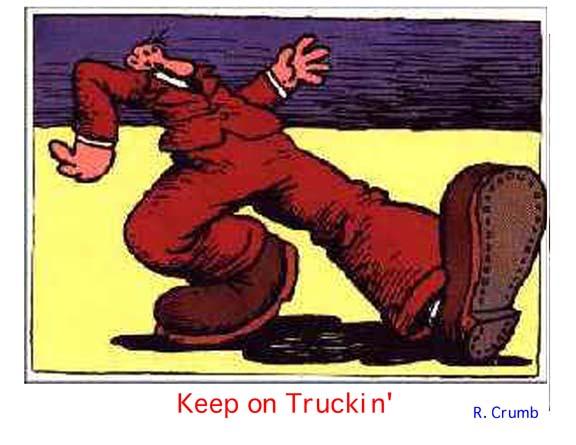
I'm feeling the national energy shortage in my legs and arms, and especially my feet and ankles.
Recently, in response to the rising cost of gasoline and the earnest imprecations of our Commander in Chief, I've begun taking the rapid transit system to and from work at least a couple of days a week. I figure if I can skip my car two days out of five I can save 40% of my personal energy consumption and make the petroleum available for those who need it more, like people on the Gulf coast who have to drive 50 miles to, well, fill up their tanks.
It works pretty well. I'm part of a fortunate minority in our county who live and work within an easy walk of the rail system. It takes only 15 minutes to get to the train, about 15 minutes on the train, and another 10 or 15 minutes on the people mover and on foot to reach my office in downtown Miami. It takes the same 45 minutes, or longer, if I drive.
On the upside, there is no lingering in bumper-to-bumper traffic, waiting for drawbridges, or narrowly avoiding collisions along the way. However, I do miss the luxuries of listening to the morning news on NPR while sipping coffee or tea as I wake up. Standing and hanging onto a metal stanchion (no seats available during the morning commute) is simply not the same. I'm thinking of getting one of those mini-radios you can plug into your ears to cover the NPR fix, but the coffee will just have to wait till I get to work--no food or beverages allowed on the train.
Financially, the two days of public transport cost me six dollars. Even if I save only a third of the gas I would use otherwise, which would be about twelve dollars worth (4 gallons), I still come out ahead. And that's without factoring in the wear and tear on the car, which would be another four or five dollars a day.
Then again, I wonder how much faster my shoes will wear out?