

 Posts
Posts


I've just read Ray Kurzweil's 1999 book, The Age of Spiritual Machines. This follow-up to his earlier volume, The Age of Intelligent Machines, attempts to predict what will happen if current technological trends continue for at least another century. Even though I'm predisposed to look favorably on the prospects, I found his conclusions challenging, not to say breathtaking.
And he's worth paying attention to. As an inventor who did seminal work on computer speech recognition, he knows what he's talking about. Many of his earlier predictions for the decade of the 1990's have turned out to be right on target.
He begins by presenting his theory of accelerating returns. The gist of this is that, having taken a long time to evolve, life took a much shorter time to develop intelligence; in less time than that, intelligent humans developed technology; and in less time than that the technology developed into computation. He makes a convincing case that evolution applies equally to social forms and to technology, and that once these things are set in motion they are destined to continue their development at ever increasing speed.
But you don't have to accept that there will never be a slowdown in technological development. If the current exponential rate of progress continues for only another few decades, computers will have vastly exceeded the storage capacity and computational ability of not only the human mind, but of ALL human minds put together. By this time they will be designing and building their own successors, and their role in our interdependent world will be so critical that it will no longer matter if they take over the world from us or not--we will be unable to live in it without them.
Those who doubt this have only to consider what would happen even now if all the computers in the world were suddenly absent or nonfunctional. Transportation, business, communication, government, weaponry, appliances, even the monetary system that supports our civilization in all its forms, all would collapse instantly. This was not true only 25 years ago; it will be vastly more true 25 years in the future.
Yet the picture Kurzweil paints is not bleak. Quite the contrary, the upside to this revolution/evolution could well be unprecedented prosperity, increased longevity and quality of life for all members of the human race, as well as their manufactured progeny.
But perhaps the most interesting part of all this is the question of what constitutes a "human being." When you look at our physical forms, it seems clear that we are not the stuff of which we are made. Our cells, and the atoms that comprise them, are constantly churning, constantly replacing and remaking themselves. The "us" in there is just a pattern, like the shape of our faces, passing through the world like a wave across the ocean.
How can we say that the pattern of consciousness must be limited to atoms arranged in a biological form and not a "manufactured" one? As we watch RNA molecules "manufacture" a new strand of DNA in our bodies, and as we contemplate building new structures at the molecular scale of nanotechnology, how can we define the difference, if there is one?
How we will feel when confronted by "manufactured" beings who claim to be equally conscious, and how we will define our own "humanity" in that situation, is a philosophical exercise we may as well start right now. It won't be long before we will need the answers.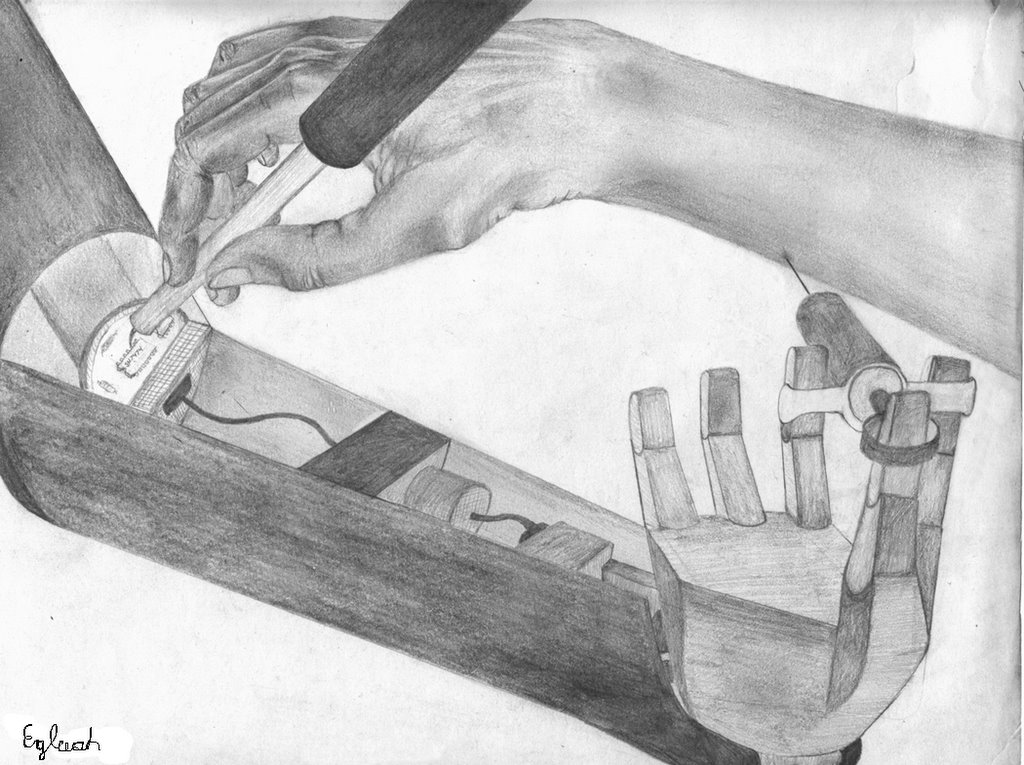
Tuesday, January 10, 2006
Spiritual Machinery


Monday, December 26, 2005
Math and Magic
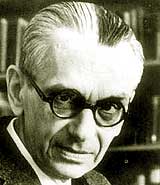
In my earlier blog on this year's Miami Book Fair, I promised to report back after I read Rebecca Goldstein's book, Incompleteness: the Proof and Paradox of Kurt Gödel, and let you know if it could actually be comprehended by a non-mathematician. Well, I've read it, and the answer is ... kind of.
Even though my mind rebelled at the limited amount of logical notation that was included, I did grasp at least the general outline of what Gödel did. And even that was enough to amaze me with its wizardry, and to give me some small appreciation of the import of his accomplishment.
The best way for me to present my take on it is to start with another author and another interesting mind. In his book, Hackers--Heroes of the Computer Revolution, Steven Levy quotes the early MIT pioneer of computer programming, Bill Gosper, as saying, "Data is just a dumb kind of programming."
This opaque proclamation, seeming to make pretensions of being deep, is really just a concise way of saying that there is no difference in a computer between a byte of program code or a byte of data, except for the context.
A computer that attempts to "run" data, executing it as a series of instructions, will certainly "crash," since the data will not conform to the precise requirements of the codes and sequences which are the syntax of the logical language of the program. Equally, a program trying to read a stream of data will likely reach the same impasse if it suddenly encounters program codes instead--the codes would not conform to the expected type of data.
Programmers know that both of these situations occur frequently as a result of logical glitches that cause the program to look in the wrong memory location for its next instruction or next piece of data.
But now imagine a computer in which data is also programming, and vice versa. This analogy is as close as I can come to understanding the method that Kurt Gödel used in his proof of "incompleteness." He devised an ingenious system of formal logic in which the statements are simultaneously logical and arithmetical--they have logical meanings and also numerical identities.
Using this system, he proceeded to show how any logically provable statement in it had a certain mathematical characteristic. So he could mathematically analyze any statement and determine if it was provable or not.
Finally, he was able to show that certain statements which are demonstrably true (because their arithmetic works) can also be proven to be unprovable (because they don't have that telltale mathematic signature of the provable ones).
If this isn't enough to bend your mind, you must already have a mind with a mathematical bent (!) and be able to imagine this with greater perfection than I can. In fact, you may have studied Gödel himself, in which case you should write to explain how I have got it all wrong. But I think, because of what Gosper said about data and programming, that I can get a glimpse of how this would work.
What it means is that Gödel created a logical system in which numbers are simultaneously logic. Code and data are one and the same, and function together to measure what is true and what is provable.
Note that truth and provability are two separate issues here. That is both the nature of the tool that Gödel used in his proof, and also what he set about to prove: that truths will always exist that we cannot logically prove. Like Plato, he believed that Truth exists quite apart from whether we can prove it, or whether we even know about it. Truth is a priori, before experience.
Most amazing about all this is that the implications of his proof (which, not being mathematicians, we will have to take on their word) reach beyond the "sandbox" of the formal system he created, beyond mathematics and logic itself, into the realm of philosophy and metaphysics. It says, provably and conclusively, that no matter what we do there will always be truths that we cannot prove are true. This cuts to our most fundamental experience as living, conscious beings--the abundant obviousness that Something exists, that we are part of it, somehow identical with it, though we will be forever unable to prove the What and Why of it, or even that we did not imagine the whole thing.
Some trick, huh? The idea that mathematics can have something so profound to tell us about our lives is incredible and almost unprecedented.
Near the end of the book, in a wonderful sidelight on Gödel's personality, Goldstein relates what happened as he was preparing for his U.S. citizenship examination. Ever the diligent student, Gödel made a thorough study of the Constitution and was startled to discover a logical flaw in it which, it seemed to him, would allow the democracy to degenerate into tyranny!
Alas, the details of this insight, like the legendary Fermat's Proof, were never recorded even by the people who told the story, and so it has been lost to posterity. Since we will be unable to patch the error with legislation, it remains for us to live out the proof. Only time will tell if Gödel left us with one more evidence of his genius.
Saturday, December 24, 2005
Unto Us a Child is Born

At each holiday season for the past few years I've found myself thinking of the words, "for unto us a child is born," and of the wonderful musical setting given to them by Handel in his Messiah.
First, the words lead me to muse on how this particular holiday has become a celebration of the child. Even though we adults give things to one another, we know it's really about that shower of presents we rain on our children (and in my case, grandchildren). And even though there was one particular child in the past whose birth this is meant to commemorate, we give our attention, appropriately, to those who are among us now.
With wisdom, the birth of each child should be taken as the great gift that it is, the miraculous appearance on earth of a new being, a new consciousness. Each one is a new blank slate on which a future may be written, each one a new hope that the future will be an improvement on the past as we grow toward a state of perfection that we glimpse as possible.
It's as if any child might be our savior--or maybe all of them, maybe each one born is one six-billionth of a savior, each contributing to the construction of the new year, the new beginning, that is always upon us. And why not? If, as Quakers believe, "there is that of God in everyone," why should we not celebrate this universal divinity by worshiping our own children?
In light of all this, the joy expressed in Handel's music, particularly in that one chorus, seems even more meaningful. I've been listening to the excellent recording of it by Christopher Hogwood and the Academy of Ancient Music, who, despite the antique aura of their name, manage to make each note breathe with fresh life.
And if that one isn't exciting enough for you, try to find the Roche Sisters Christmas album. Their version has all the vitality of their legendary a capella performance of the Halleluia Chorus, and adds the contemporary touch of tasteful electric bass and synthesizers, with voice doubling effects to sweeten their angelic sound even further. On top of that, they came up with an inspired concluding sequence of descending tones that nails down the message with magnificent finality.
Each time they arrive at the part that says, "His name shall be called," it gives me chills as they seem to add the exclamation points that the text cries out for. Let me leave you with this:
And his name shall be called ...
Wonderful!
Counselor!
The mighty God!
The everlasting Father!
The Prince of Peace.