


 Posts
Posts


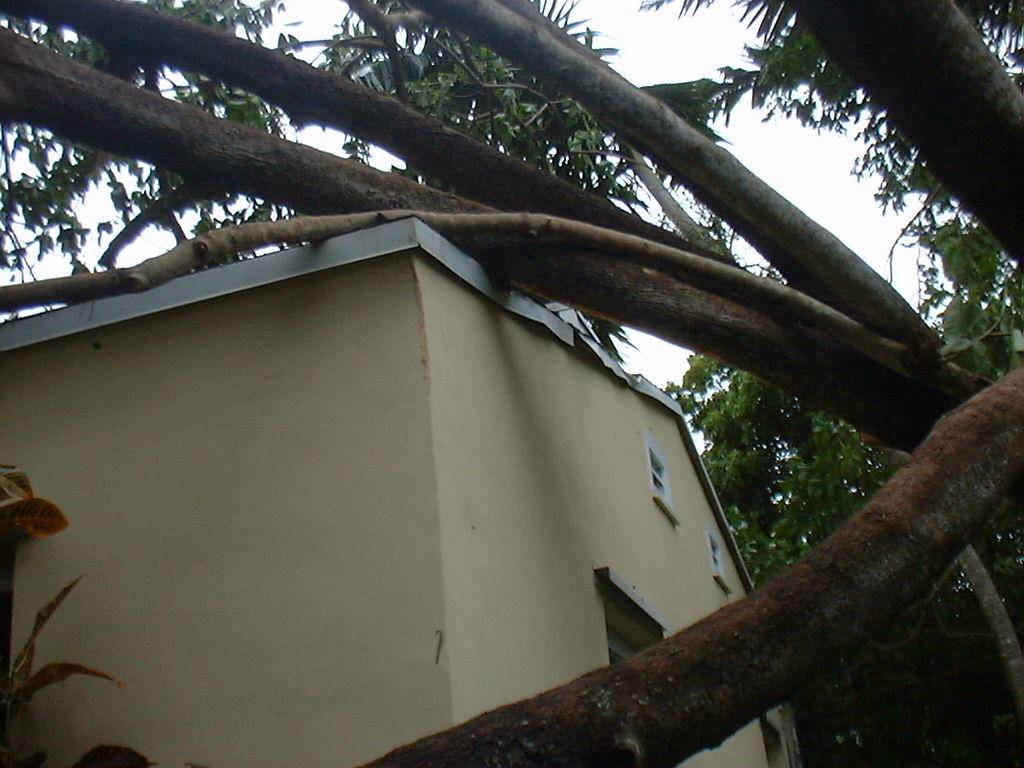
As blasé Miamians, when we heard that a mere "tropical storm" that might just barely turn into a category one hurricane was approaching, and which furthermore would be passing some 50 miles to the north of us, we figured we were in for no more than a couple of rainy evenings watching it all on TV.
Bzzt! Wrong. At the last minute Katrina intensified further and made a sharp southerly turn, bringing the eye right through the city of Hialeah, only about 15 miles from our South Miami abode. Instead of the 30 to 50 mph winds that had been predicted we were getting gusts above 80. Time to start wishing I'd put up the shutters and bought more supplies.
Around 8:30 the lights went out. Nothing out of the ordinary about that. But about an hour later came a tremendous BOOM--sounded like thunder crashing right overhead. This was followed by some strange noises that led us to look around the house, carrying flashlights like we were in an episode of the X-Files. In the back bedroom we discovered a hole in the ceiling with about six inches of wood sticking out. It was the end of a branch of the rather large tree that had fallen on the roof, punching its way through roof and ceiling. Luckily it also pretty much sealed up the hole it had made so we were able to catch the small amounts of water that ran down it in a waste basket.
Around this time one of my cats, the least intelligent of the three, who had disappeared prior to the storm, decided to turn up and request admittance, so I had to go out and carry her in to safety. While I was outside I went to look at the tree. One of its two trunks, a good sixteen to eighteen inches in diameter, had split right to the base and was resting on top of the roof. No wonder it had made a noise--the whole roof had acted like a soundbox to amplify it.
The tree is still there, because so far we have failed to get any tree trimming company to actually show up. The morning after, we were able to patch the hole temporarily by sawing the branch off at roof level--leaving the rest of it inside--and covering it with tarpaper and caulking. The predictable aftermath has happened, with traffic lights out, stores closed, food and water and batteries in short supply, and lots of yard work to do. I now have a pile of debris the size of a small truck out by the road, with more to come. But we're more than grateful not to have worse damage or the kind of flooding that occurred further south from us.
So here we are, only a few days later, with our power back on, A/C running again, no more cold showers or lukewarm bottles of water or suffocating heat, just in time to see what the same storm, vastly increased in size and power, will do to poor old New Orleans. Having been through that with Hurricane Andrew in 1992, I can only wish them good luck. As low as we are, at least Miami is above sea level.
Monday, August 29, 2005
Katrina: No Such Thing as a "Small" Hurricane


Tuesday, August 23, 2005
Farewell to Robert Moog

The death of Robert Moog was announced today, causing many
of us to reflect on the size of the contributions he made to
electronic music.
It's easy to forget now how primitive the equipment was and
how difficult to work with prior to Moog's development of the
first "synthesizer." Composition in those days (prior to 1967
or so) was a labor for lab technicians using oscilloscopes to study
wave forms produced by oscillators, and modifying them with
amplifiers and filter circuits. Much was also done by
manipulating magnetic tape, physically splicing different tones
together and altering the speed and direction of playback.
Moog's packaged system created new possibilities which are
still being explored today. By bundling an assortment of
oscillators, amplifiers and filters together, and allowing them
to be "patched" together in various ways (using "patch cords"
that plugged into the panel like an old telephone switchboard),
and finally by allowing the whole thing to be controlled by a
piano-style keyboard, he created a truly playable instrument.
Wendy (née Walter) Carlos arranged and played Bach on the
thing, and the world was never the same. It's hard to remember
now, with all the electronic tones in the air, what a revolution
that "Switched-On Bach" sound was at the beginning. You
actually had to learn how to hear it.
One track in particular, the slow movement Carlos improvised
for the Brandenburg Concerto, sounded at first like a bewildering
mix of sound effects that had nothing to do with traditional scales
and notes. Then one day when I was, shall we say, intoxicated
(it was the 60's, after all!), I discovered that I could remember
and "play back" in my mind the whole thing, with all the electronic
bells and whistles. My brain had figured out how to listen, and had
recorded it for me. Afterwards, when I played the record again,
I could hear the traditional baroque-styled notes that underlay
the sounds, and it seemed perfectly comprehensible.
Like every great invention, the Moog synthesizer was rapidly
imitated and improved upon by others. The machines became
easier to "patch," using knobs and buttons instead of cords.
They became polyphonic (the early ones could only produce one
note at a time, and recordings had to be made of many tracks put
down in layers). The electronic modules that produced the sounds
kept shrinking, riding the parallel wave of computer technology,
until whole synthesizers were reduced to the size of chips. Finally,
they have become purely digital, and hard to distinguish from
computers themselves.
It's a wonderful footnote to Moog's life that his early interest in
electronic music dates back to his childhood when he built a theremin
from instructions in an electronics magazine. The theremin, named
after it's 1919 inventor Leon Theremin, is a purely analog device
played with a pair of antennas that respond to proximity. One
antenna controls pitch while the other controls volume. Though
simple in principle, the thing is darn hard to play. Anyone can make
weird sci-fi UFO whistles, but few have had the patience to learn
the control necessary to play real music, which is why it has
remained a curiousity rather than developing into a mainstream
instrument.
Late in his life Moog saw to it that one of the few theremin virtuosos,
Clara Rockmore, was properly recorded for posterity. Her album
very simply has no peer. In her hands (or maybe I should say, near
her hands) the instrument literally sings, sounding like a cross
between a viola and a contralto voice. Her performance of the
Rachmaninoff "Vocalise" deserves to be legendary.
So in returning to the roots of his inspiration Moog left us with yet
another gift. Thanks for everything, Bob!
Thursday, August 18, 2005
Protesting the War in Iraq
What a way to begin this journal--back to the barricades in
protest over the war. Talk about 60's flashbacks ...
Our local Friends Meeting (Quakers) has been maintaining a
weekly peace vigil in front of the meeting house since before
the invasion of Iraq began, back when we still hoped it could be
averted. A small contingent, sometimes only two or three, have
stood by the road with their signs and waved patiently at
homeward bound motorists during the evening rush hour.
Having been present myself in this small gathering, it was
absolutely exhilarating to find ourselves suddenly joined by
close to a hundred fellow activists organized through MoveOn to
demonstrate in sympathy with Cindy Sheehan, still camped out in
Crawford, Texas.
Motorist response, as always, was overwhelmingly positive. For
every shout of "you [bleeping] idiots!" there were ten carloads of
honking horns, waves, peace signs, thumbs up, and other
expressions of glee and support. One young girl, of elementary
school age, interviewed people for a school project, with Dad
manning the videocam.
Channel 7 was on the scene, too, and taped scenes and interviews
for the late news. Typically, when we waited up to see
ourselves, the news led with a story about animal cruelty and
the usual litany of car accidents before delivering 15 seconds
of video (no sound) on the protest.
Well, if you have to watch the news to find out what's
happening, then you just need to get out more.