-->
Showing posts with label religion. Show all posts

Friday, April 19, 2013

Singing Praises

What better reason to burst into song?

Of all things, I discovered the singing of hymns at our annual gathering of Quakers in Florida. This might sound unexpected, especially if you know how rare singing is in our kind of silent Quaker meetings. In contrast to some other churches where music and song are big parts of the Sunday service, we can go a whole year without piping up a single note until the annual Christmas season causes us to lift the lid on the piano and dust off those books of carols.

There are exceptions. We have one attender who often gives his spoken messages in the form of impromptu song. And there was the time when our visitor from Haiti, whose sister had been injured in the earthquake there, led us in the spontaneous singing of a hymn whose appropriate refrain was "Alleluiah!"

But at this annual gathering we happened to stumble into a workshop on "chanting." For an hour a group of us were led in singing some simple plainsong that more resembled Gregorian chants than traditional hymns. The tunes were easy to pick up, and the words simple enough to learn after hearing them once or twice. Each was repeated "until it was over," which happened by mutual consent. The substance of the text was basically Christian, but broad enough to appeal to a wider range of kindred spirits. The experience was deeply peaceful and surprisingly emotional. Not to mention auditorially pleasing. Even our untutored voices began to sound good in the small reverberant meditation chapel where it was held.

Encouraged by this experience, I later joined a group clustered around the piano in the dining hall to sing from a hymnal. We even did that same Alleluiah piece that I remembered our visitor leading us in. I had a good time and it was over too soon. But I had one more treat in store. Before our evening business meeting an a capella chorus performed a favorite of a recently departed friend. I haven't yet tracked it down by title, but it contained a "hook" that has stayed with me since, a particular phrase that repeated, "here I am, Lord, can you hear me?" Listening to this, I felt certain the singers were heard. Certainly by me.

Home again I felt led to download an entire collection of hymns. I found one called History of the Hymnal that contains 100 hymns -- count 'em, 100! -- for the bargain basement price of only 9.49. (You can use the link to hear samples courtesy of Amazon.) Not bad for the equivalent of 3 packed CD's. But what really drew me to this particular collection was the sound of the small vocal ensemble. They perfectly capture the flavor of a small congregation with a basic organ, or a group of friends gathered around a piano. Occasionally there is a soloist or duet for variety, but generally one tune leads gracefully to the next, with simple harmonies and a sound clear enough to make the words intelligible. There's no attempt to jazz things up with modern instruments, no gospel wailing, no Mormon Tabernacle Choir, just human voices lifted in songs of praise.

So I've been walking around listening to this collection, not tired of it yet, feeling it sink into me and have an effect. You don't even have to go along with all the theology in the lyrics to get the underlying message of peace, calm, and centeredness. It's written into the effortless phrasing, the solid chord progressions that have been with us for centuries, a liturgy that has grown by accumulation over the years. You can even sing along if you want to. Part of me is still singing.

Monday, June 01, 2009

God on the Brain

So who created whom?

Recently several scientific articles have been published that describe how a belief in God and the idea of Creation may be "wired" into our brains, and that these beliefs may have evolved in us because they were beneficial to our survival.

Oddly enough, the first conclusion that comes to mind is that this means God is just a figment of our imaginations. But this is just another example of how our minds work. Belief in something is no proof it is false any more than it proves it is true; it is simply belief. Our beliefs may be based on observation, logical deduction, and reasoning, or they may be based on faith, superstition, or whatever innate sense we have of right and wrong. Belief can even be purely pragmatic, leading us to believe whatever seems to work at the moment, even if it is contradictory. Thus I might be an ardent supporter of the right to privacy, but still be in favor of wiretapping when it makes me feel safer. (It doesn't, by the way.)

As to the survival value of religious systems, you could certainly argue both ways. It might be the case that believing in something larger than ourselves can induce us to sacrifice our individual survival for that of the whole species. On the other hand, look how quickly Christianity evolved from a doctrine of love and charity to the bloodbath of the Crusades and the horrors of the Inquisition. Wouldn't we have done better to avoid those chapters of our history? Of course, some would argue that is what happens when we turn religious faith into religious organizations or institutions, which behave more the way states and politicians behave than like the figures such as Jesus and Buddha who inspired them.

And when it comes to personal sacrifice, consider the case of the house cat I saw on the news who repeatedly entered a burning house to pull out her kittens one by one. The poor feline had her ears burned, her eyes blistered shut, and the fur singed from her face, yet she saved their lives. It would seem that we could achieve as much for our collective survival just by emulating this cat, tapping into this same deeply seated instinct in our own animal brains, without having to resort to a belief in anything supernatural.

I'm a little surprised there hasn't been more of an outcry against this new research by the proponents of Intelligent Design. You might expect it to start another round in the battle of the Jesus-fish emblems seen on the backs of cars. You know the ones. The first fish contains the letters "Jesus." The second fish, with legs, contains "Darwin." The third fish is a pair of them -- a smaller Darwin fish being eaten by a larger one labeled "TRUTH." And now we seem to have the potential for an Evolution fish big enough to swallow a God fish.


But I think a better parable would be the one about Li Po, the ancient Chinese poet who, on waking up, could not decide if he had been dreaming he was a butterfly, of if he were now a butterfly dreaming he was Li Po. If God did not exist, would we create one? If God created us, would we believe it? If we didn't believe it would it still be true? If we were God, and forgot how we had created ourselves, could we find out?

Monday, April 13, 2009

Message Received


I think I must look like someone who is looking for a spiritual message, because people keep giving them to me. Last year, for instance, something reminded me of my grandmother's rosary, then two days later a rosary arrived in the mail, prompting me to explore the history and use of this religious artifact. What are the odds?

Several years ago I had a brief meeting at work with a carpenter about possibly doing some work for our company. Apparently giving him my business card was enough to get me added to his Christmas card list, because for the next two years I received cards from him that were beautiful reproductions of early Renaissance triptychs, with little paper doors that opened up to show the inner panels. Even though they are Catholic images I have kept them atop my piano because they're just too good to be thrown away.


One day I was helping one of my coworkers with her computer when I noticed a Biblical chapter and verse on a little note attached to her monitor. That sent me to look it up because I was curious what was so important to her that she would want to be reminded of it every day.

Sometimes on Saturdays we are visited at home by the Jehovah's Witnesses, those quiet and earnest people whose main concern seems to be giving their good news to as many people as possible. I used to just smile at them and say "thanks anyway" before closing the door, because there was no need to be rude. But now I have a grandchild who likes to talk about God and doesn't get the chance often enough. On his behalf my wife has invited the Witnesses to sit on the porch and show him their pretty pictures of paradise on Earth, while she stands by to make sure he doesn't get the wrong idea.

What do I mean by that? Well, for example, there is a long leap from saying God loves you to saying that the world is only six thousand years old. While the first statement can be considered at least metaphorically or poetically true, if not literally, the second is so patently false that it drives me to climb walls to get away from it.

This is why I don't sit in on these discussions myself. Once my wife alluded to "millions of years ago when the world began," and one of the sweet ladies in white protested, "Oh, it ain't no millions." At which point I throw up my hands and say, Here we go again. It's back to the Scopes trial and Inherit the Wind and the recent confrontations with creation Creative Designers in the public schools. If only they could just content themselves with the God-loves-you part. So I guess there are some messages I still refuse.

But what I really want to talk about is the most recent example. While I was sitting in a doctor's waiting room a woman came up to me, handed me a card, and said "God bless you." Now, it used to be when someone came at me that way I would get defensive and say "no thanks" to their offer. But these days I tend to accept the gift and give thanks for it. So I found myself holding a little card about the same size as one of those Chance cards that you pull from the deck in the game of Monopoly, and this one came up "Forgiveness."

On one side was a Biblical quotation on the subject. On the other was one of those melodramatic religious paintings designed to induce a Thought. In this case I found an intriguing puzzle. The painting shows a fairly young, well-built man holding a mallet in one hand as if he has been pounding away at something. Evidently that thing was so difficult or so frustrating or so impossible that he has collapsed from the effort. Jesus, standing behind him, has caught him in his arms. You can tell that Jesus is really strong, because this strapping young man must weigh a good 170 pounds and Jesus has no trouble holding him up.

I still have the card, and I still haven't figured out how to take it, but I'm enjoying contemplating the mystery and the questions it evokes: What was the man doing that was so difficult that he had to give up, to surrender like that? If I tried it, would someone catch me? Do I need forgiveness? Who can grant forgiveness? What would it mean to be forgiven? Somehow I'm enriched just by having the questions on my mind.

I'm sure I'll be keeping this card, too, along with another one that I found one morning lying on top of a hedge near the sidewalk, just waiting to be plucked like a bloom. I don't remember the message on that one -- something in Spanish about a Saint -- but it must have been intended for me because I'm the one who picked it up, and put it in my pocket, and took it home, as if it were a seashell from the beach.

Such things must be coming at us all the time, not always clad in religious garb. It's up to us to accept them, and accept, and accept.

Sunday, February 22, 2009

Why I Am Not An Atheist


There's a wonderful poem by Frank O'Hara called "Why I Am Not a Painter," which, by giving an example of what poetry is not, gives as good a demonstration of what it is as I have ever heard. [This is the painting he refers to. >>]

So thinking about atheists recently, following their support for Darwin Day, I wondered why I'm not one of them. After all, their position is really about questioning, and I've always believed we learn more by questioning than we do by accepting things on faith. I'm also a believer in science and its method of arriving at the truth by observation. So why shouldn't I expect some sort of physical proof of God's existence? Bertrand Russell, for example, when asked what he would say if he were to die and find himself confronting God, replied, "I would say, 'You didn't give us enough evidence.'"

There's nothing wrong with faith itself, but there was nothing wrong with believing the Earth was flat, either -- except that, since it wasn't, we probably wouldn't ever have learned to orbit around it, or depart from it for the moon. Now that we know how spherical it is, we can have faith in that while remaining open to whatever other possibilities there might be, such as a warp in the four-dimensional space-time continuum.

My first encounter with the concept of atheism came when I was about fifteen. Over summer vacation I had read The Story of Philosophy, by Will and Ariel Durant, and then discovered a book on my father's shelves called A Game of Chess (author unknown). This turned out not to be about chess at all. Instead it was a philosophical dialog conducted between two men over a chess board. One of them (the hero) was an atheist, and the other (I guess you would call him the goat) seemed to have been placed there by the author to feed the atheist exactly the arguments that he could refute with wit and alacrity.

As you can tell, the book was pretty bad, even in sophomoric terms. I don't remember, but no doubt the story ended with the atheist declaring "checkmate!" Nevertheless I read the whole thing, even though the further I went the more I felt certain that I disagreed. No, it was stronger than that. Something inside me disagreed, giving me almost a physical sense of claustrophobia and discomfort.

You might ask at this point what my father was doing with this book on his shelf. Well, that would be a long story, but the short version is that after having been raised as a Catholic he found himself suddenly transported into the later stages of the Second World War, where all the Catholics, Protestants, etc., remaining in Europe were doing their best to murder one another. After being shot himself, he was transported back to what later veterans would call "The World" and plunked into Columbia University where he was exposed to other philosophies of all kinds. Let's just say his faith was tested, and it flunked. By the time he had married my mother he no longer felt comfortable as a Catholic and had stopped attending church. He felt strongly enough about it that he eventually persuaded my mom to follow suit, with the result that I have only the foggiest early memories of ever attending mass.

Later they went church shopping, largely so that my sister and I could have something to call a religious background of our own. They settled on the Unitarians. This was partly because the organist liked to play Bach, and they were both fans of Albert Schweitzer, but also because of the inclusiveness and open-mindedness of the Unitarians, who, like the Quakers, find room even for those of no faith at all. This varies a lot from one congregation to another, but the one in Miami was so progressive that in the 1970's the minister created a furor by coming out in favor of legalizing marijuana, though as he put it, "I still have my doubts about LSD."

I've written elsewhere about my first exposure to the Unitarian church school, which involved lots of natural history (the teacher was also a middle-school science teacher), classical mythology, and comparative religion. When I went back in my teens it was a place to learn about Bob Dylan, sing folk songs, and debate Civil Rights issues with local political candidates. But the point is that this was the foundation for my own spiritual search, which began with Alan Watts teaching zen on TV and then the Durant's introduction to philosophy, and continued on through the years up till today. The Unitarians didn't ever tell me what to think; they gave me information and encouraged me to think for myself. Eventually I ended up as a Quaker for the same reason.

Meanwhile my dad, ever restless, had abandoned the Unitarians as "a bunch of neurotic intellectuals." Somewhere in the void beyond he experimented with atheism before drawing back, unable to take the leap, and declaring himself firmly agnostic. (That position, being firmly on the fence, has always seemed to me an indication that you would like to believe in something but have not yet found a compelling argument.) Late in his life he dabbled with astrology and formed a conviction that the planets were against him -- especially the distant, slow-moving ones. Yet there are traces in the poetry he left behind that he experienced a sense of grandeur when contemplating the universe that held the same place for him that God, prayer, and religious grace hold for the believer.

Which brings us back to poetry, where we began. No doubt this could be a lot shorter if I wrote it as a poem, but it's got me thinking that the real answer to Why I Am Not An Atheist has as much to do with poetry as it does with philosophy and religion. It's emotional and experiential, not logical and rational. Since becoming a Quaker I've become comfortable with the idea that "there is that of God in everyone." To me this means much more than having something like life or a soul given to me as a gift; it is an immediate awareness of a direct connection to, and unity with, a universal spirit. In Hinduism they use the term atman, which means God as manifested in the human -- God as existing in the human -- and that means every human, not just the rare incarnations of the divine such as Jesus or Krishna.

So that part of me that became so uncomfortable when I read the atheist book was the deepest part of myself, my most true nature, and the part that is one with that universal spirit. It's hard to see because it is so obvious -- we are aware, and we are aware that we are aware. Through us the universe itself is alive and aware. We are parts of a living, conscious thing, and we know it because we are living and conscious. And quite simply, no matter how much atheists may speak of human values, it seems to me that the universe they inhabit is dead, a lonely meaningless place in which life arose as a fluke and must do the best it can against the void that surrounds it. However much we may have in common in this view, we are all separate, rather than being equal manifestations of the same cosmic urge to intelligence.

Neitzche's famous declaration that "God is dead" may have had some sociological importance back in the 19th century, but it makes as much sense to me as declaring "I am dead." And that's why that book about atheism made me so uncomfortable. It was endless arguments for why that thing within me did not exist -- and all the while that thing within me was protesting, like someone being buried alive in a coffin, "No -- no -- I'm alive -- I'm in here!"

Cosmologists, wondering why the physical constants of the universe appear to be perfectly arranged to make life possible, are forced to consider the possibility that they are the way they are simply because we exist -- we can only observe a universe in which life is possible, even if there might be other universes in which life, or even stars and galaxies, are not possible. Quite likely we will never know if this set of fortuitous conditions is just one of an infinite series of random possibilities, or if a powerful Demiurge compels it to be only this way.

But it doesn't really matter if there are other lifeless universes or not. Just as there are lifeless planets sharing the space around our own sun, we could be surrounded by other lifeless universes and yet we would still be alive. It comes down to the pure, age-old question: Why is there Everything instead of Nothing?

Those who would seek a rational explanation for this are probably doomed to disappointment. Like the forlorn characters in the fiction of Flannery O'Connor, who are driven to deny their own deepest beliefs, they may eventually come around or be brought up short by some impasse that convinces them.

The vastness that contains us has burst into being somehow of its own volition, and whatever force compels it to exist has brought us into being to bear witness to the miracle. Let us then watch, and listen, and be.

Saturday, December 20, 2008

Wrestling With the Rosary

Merry Christmas -- with apologies from a lapsed Catholic ...

When my mother died I inherited two Madonnas -- no, not the singer, which is what you get if you do a search online, but the one named Mary who gave birth to a most famous Son apparently in a rare case of parthenogenesis. These small statues, one of wood, the other ivory (before it was illegal!), were brought back from Europe as gifts for my mom when my father returned from fighting World War II.

My family left the Catholic Church when I was very small, so these figures never acquired religious significance for me. But in keeping them I find they remind me of my mother, and of my connection to both of my parents.

Another mysterious symbol I have always remembered from my childhood was my grandmother's rosary. She most emphatically did not leave the Church, and spent part of her time praying for those of us who had.

Whenever my sister and I visited her apartment one of the things we did was to explore her jewelry box to find the rosary she had stashed away in there. This mystical artifact, its purpose unknown to us, with its silver cross and beads of black cut glass, seemed to point to something beyond, and fascinated us.

In one of those bizarre coincidences that are not really uncommon in life, a rosary arrived in my mail recently, barely two days after I found myself remembering these things. (As always, there is a logical explanation: the local charity, Camillus House, had sent it out with an appeal for donations for the homeless. But that takes nothing away from the delight of the coincidence.)

So, as you must do when such an occasion lands in your lap, I decided to finally discover what the rosary was all about. I already knew by now that it was an aid to repetitious prayer, and that at least part of it involved the Hail Mary -- the one so widely known that it has become the name of a play in football where you just let loose with the long ball and pray for success.

Camillus thoughtfully enclosed a brochure of instructions for how to pray the rosary, so that's where I began. The title was "Praying the Rosary - An Easy Guide." I suppose it is easy enough, since the instructions were all in English (no Latin grammar required) and the steps were as simple as 1,2,3 ... 4,5,6,7,8,9, and 10. Here's where I took my first deep breath.

The rest of the instructions consisted of the text of the seven (seven!) different prayers to be repeated, and then a list of four sets of five (=20) Mysteries to be contemplated while engaged in the repetitions. First talk, then chew gum. Got it.

Setting the Mysteries aside for another day, I launched into the prayers. One of them, the Our Father, I already knew, thanks to several years of primary school in that simpler time when we began each day with a prayer and the Pledge of Allegiance to the Flag (under God) and didn't even know it was bad for us.

Another one, the aforementioned Hail Mary, I almost knew -- and that was just as well, because I would have to repeat it a whopping 53 times, far more than any of the others, which I suppose is intended to stress the centrality of Mary in all this.

But before I could get on to these two old friends I first had to get past the Apostles' Creed, which I'd never seen or heard before. Right away I was troubled. This begins with the words "I believe," followed by quite a list: God (no problem there), Jesus (of course I believe he existed, it's well documented) (but that he was God's only son? Wasn't he telling us we are all children of God and should act accordingly?) (that he rose from the dead? -- books have been written about this) (and that he's coming back "to judge the living and the dead?" -- the same guy who challenged us to cast the first stone?) ...

But wait, there's more: the Holy Spirit (sounds fine), the Catholic Church (whoa), "the communion of saints" (need to look it up), forgiveness of sins (I certainly hope so), the resurrection of the body (do we really want our bodies back after they're dead? sounds macabre), and life everlasting (okay, but no dead body, please). So you see I had a few questions and issues.

And that was just for openers. At least it is only said one time. Then after a hop (Our Father), skip (3 Hail Mary's), and a jump (the Glory Be or Doxology), it was on to the first of the day's 5 mysteries. These are categorized and assigned to days of the week, but since there are 4 groups and only 7 days the Luminous Mysteries get short-changed and are only said once on Thursdays. The others groups are Joyful, Sorrowful, and Glorious. (Stop snickering back there with your Grumpy and Bashful.)


I confess (not in the Catholic sense) that I have not paid due attention yet to the Mysteries. They are all notable incidents from the Gospels, and certainly worthy of contemplation. But before I got to that page I stumbled across a typo in the "Let Us Pray" section of the Hail Holy Queen. There was a phrase that read "while meditation on these Mysteries," which was clearly intended to say "while meditating on" or "while in meditation on."

Such a small thing, really. The kind of mistake that must have plagued the monks who spent their lives copying books by hand. But it reminded me of finding a similar typo in Stephen Hawking's book, A Brief History of Time. Somewhere in the first few pages, at the end of a dense and difficult paragraph, the sentence that summed up the gist of the paragraph -- what we used to call in English class the "topic sentence" -- stated the exact opposite due to the insertion of a single "not" (or the absence of one, I'm not sure which). Again, a tiny flaw in a wonderful manuscript, but one that might have caused some readers to decide that they would never be able to understand the remainder of the book if this paragraph meant the opposite of what they thought it said.

So here was a similar issue in a prayer, a carefully formulated string of words that was meant to be said properly, yet flawed with the potential of other errors that might be less apparent. What if someone learned to do it wrong?

Another example was the Glory Be to the Father, which was by far my favorite part: "Glory be to the Father, and to the Son, and to the Holy Spirit. As it was in the beginning, is now, and ever shall be, world without end. Amen." A strong and clear affirmation of divinity in all its forms, and recognition of the eternal -- what's wrong with that? Nothing. But the brochure seemed to say it was optional ... or it might have meant the next part was optional, again unclear. And what did it say about my affinity for all this if my favorite part was the only one considered optional and able to be omitted altogether?

By this time I had become curious where the tradition came from and how far back it went, because I was pretty sure it was not something that Jesus did or even talked about. I did some research online and learned that early monks from the first few centuries used strings with knots in them to keep track of their prayers, and that a principle practice was to recite the psalms of David. Well, they were into some good poetry and rich imagery then.

At some point beads began to be used in place of knots. In fact, the word "bead" comes from the Latin word "bede" for prayer. So you might say the word preceded the object as it did "In the Beginning."

The modern rosary only goes back to the 12th century when a monk who had been fasting and otherwise distressing his body fell into a coma. While unconscious he had a vision of the Blessed Virgin, who personally gave him the instructions he was to follow. Upon waking up he proceeded to spread the custom far and wide. Evidently visions from a coma were all the proof people needed back then.

If you know my scientific turn of mind you will be able to imagine the kind of sinking feeling that had come over me by now. But that was nothing compared to the further instructions I found on how to pray the rosary properly.

This online source, which I won't hold up for ridicule by name, stressed the importance of correctness in the process. You are supposed to imagine Jesus and his Mother standing before you. On your right hand your Guardian Angel (you do have one, don't you?) collects the roses you produce with each repetition and weaves them into a crown to adorn the heads of the holy duo. Since these are spiritual roses they will never die, but will continue to pile up. (Heaven must be loaded with them by now, though I would have thought Jesus had enough of the thorns while he was here among us.) But wait -- you mustn't forget that on your left hand is the Devil who is just waiting for your attention to wander so that you screw up one of your roses, and who then grabs it and "writes it in his book of death!"

Well, there you have it. That's as far as I got. Heaving a big sigh, and feeling sympathy for any children who are being frightened by this, I finally had to recognize that the same forces that drove my parents into Catholic exile were still at work in me, leading me to question everything, accept nothing on faith alone, and to find my own way in my own spiritual world. God, I feel sure, welcomes my earnest search for the truth no more or less than the earnest prayers, or attempts at prayer, of those who conform to the various rituals of their churches.

At meeting, we Quakers sit in silence and listen for the truth, whenever and however it may appear. That too is a ritual and can be done wrong, yet no one is ever threatened with death, and it is never implied that there is anything inherently better about the right hand than the left. Perhaps I will find myself contemplating a mystery there, whether it is one of the ones on the official list or not. I might even discover that the words of the Doxology or the Hail Mary are still with me, rosary or not.

But then again, maybe I'll just remember my grandma.

Sunday, July 13, 2008

The Simple Truth

Here's something for a Sunday, also known as First Day ...


In a rare moment of perfect clarity the other day I suddenly realized that the fundamental truth I believe in is absolutely simple. But before I set down what it is, some background is in order.

The path of my spiritual quest has been a long and winding one. I was born Catholic, but my parents left the church (excuse me, "The Church") when I was about five years old, leaving me only the dimmest memories of candles, incense, and priests intoning Latin prayers. We spent some time as Unitarians until my dad left us and decided he was agnostic if not atheistic. Later still my mom joined a Congregational church until she moved and became Presbyterian. (If we can believe a recent poll, such church-hopping is widespread in contemporary America.)

So you could say I come from a family of seekers. First my parents and then the Unitarians had encouraged me to figure things out for myself, to discover what I believed rather than being told. Accordingly, while still a child I experimented with both prayer and self-hypnosis. Of the two, hypnosis seemed the most promising to me. While saying the words of a prayer I was acutely conscious of talking to myself with no one listening. On the other hand, my attempts to hypnotize myself (inspired by an article in a magazine) were really the first steps toward meditation, the inward focus which I later came to believe was the best path to true spiritual awareness.
 
While I was in junior high school and still attending the Unitarian "Liberal Religious Youth" meetings, Alan Watts began to broadcast his weekly Public TV program from San Francisco called "The Way of Zen." These wonderful 30-minute lectures, delivered in Watts' calm and measured tones, were like an oasis of sanity in the chaos of the rest of my life. Covering the philosophy and practices of not only Zen but traditional Buddhism, Hinduism, and Taoism, the real subject was Watts' own philosophy, culled from all these sources in the Orient. This led me to try a form of meditation, a simple focusing of the mind by staring into a candle flame. 

Watts had become my first guru, or spiritual teacher. Through the course of the 1960's and 70's I seem to have consumed most of the books he published as fast as they came out. Besides The Way of Zen they included This is It, Psychotherapy East and West, The Joyous Cosmology, and one of my favorites, THE BOOK: On the Taboo Against Knowing Who You Are. 

This last volume includes a wonderful creation myth that he invented to tell children. It goes something like this:
In the beginning God was all alone. He had no one to play with. So what he did was to split himself up into millions and millions of pieces, putting a little bit of himself into each piece. And he arranged that each piece should forget who it was, so that they could go out and play with each other and have the great adventure of discovering their true identity.
What a story! His point, of course, is that to declare that we are God is the greatest blasphemy in our society, as well as definitive proof that we are stark raving nuts. Yet it is the ultimate truth taught by many of the world's religions and philosophies. It is certainly the belief of Quakers, who hold that "there is that of God in everyone," and who practice sitting in silence to attune themselves to the "still, small voice within" that comes from the deepest part of ourselves, the part that is connected to, and at one with, the supreme consciousness. In Hinduism one of the aspects of God is atman, the part that dwells within the human. It is not a separate entity but rather the unifying connection between us and the divine. And wasn't Jesus trying to tell us that we are all children of God, not just him?

Suffice to say that in my better moments I have been on this path ever since, looking for that connection to my own true identity. Sometimes I have become lost in the world and forgotten what the point of it all is, and other times something has called me back to the quest. I read many other books, including the Tao Te Ching, the ancient Taoist text that is a model of simplicity, William James' Varieties of Religious Experience, Aldous Huxley's The Perennial Philosophy, and Zen Flesh, Zen Bones, a wonderful collection of stories about the Zen masters of China and Japan. I read Carl Jung's autobiography, Memories, Dreams and Reflections, some of Carlos Casteneda's dubious volumes about his Yaqui Indian teacher, Don Juan, as well as The Tibetan Book of the Dead. I read the essays of naturalist Loren Eisley, and about the search for the ultimate size and shape and nature of the universe as it is being explored through science.

Through it all I had countless hours of discussion with my friend, artist Richard Sevigny, comparing the Christian mystical tradition with that of the East. And always I looked for direct religious experience of my own in many places, including yoga, psychoactive drugs, and Transcendental Meditation. 

The Question 

Years passed. I grew up and grew older, became comfortable with what I knew and what I thought I believed and did not believe. I had got to a point where I didn't really think about it anymore. Then one day, not long after I began attending the Miami Friends Meeting, my sister-in-law asked me point blank, "Do you believe in God?"

I was disconcerted to find that the question brought me up short. I flipped through the catalog of things I knew and thought, trying to figure out if the complex mess of readings, meditations, conversations, and life experiences in my head amounted to a belief in God. I can't even remember exactly how I replied except that it amounted to a kind of, sort of, qualified, yes.

How could that be? Wasn't I sure after all those years? Was it just a question of terminology? Of course I didn't think there was a bearded old man in the sky demanding my worship and obedience, but that wasn't the question. The real question was, could I apply the name of God to whatever it was that I did believe in? But what I believed had come from so many sources, and had as much to do with science and philosophy as it did with religion and spiritual things. It was just too complicated.

I suppose I have continued to look for the answer for the past several years. But in Quaker fashion I have done so mostly by sitting quietly and waiting to see what comes to me. And finally, with a calm certainty, like the proverbial pool of water settling until it becomes clear, I came to this:

I believe that only one thing exists.

It is huge, multifaceted, complex beyond imagining, at once infinitely large and incomprehensibly small. We are all in it, yet it lives in us as well. The simple fact that it exists is so obvious it is almost impossible to frame a way to question it. It is the forest we can't see for the trees. It is sometimes called "reality." We may as well name it God. And not to believe in it is to deny all the evidence of our minds and senses.

There is a Zen story that points in the right direction: One day the student comes to his master and says, "I've reached enlightenment. Nothing exists." Whereupon the master smacks him in the head with his fan. "Ouch!" says the startled student. "If nothing exists," the master says, "then what are you complaining about?"

It's that simple. If we don't believe in God, then what is this all around us, smacking us in the face every moment? What is this divine spark within us that can contain the concept of an entire universe in each of our heads?


I don't believe in God also, I believe in God only.

That's it. That's all it is. Everything else I can say about it is mere embroidery. The divine being that the world's religions have been urging us toward is no different from that Holy Grail of modern science, the Grand Unified Theory that will describe all the laws of nature as the operation of a single law that includes them all. The equations will be written in the language of mathematics, but the subject will be the same as the holiest of sacred books, because there is nothing else to write about but all there is.


Time to be quiet now. Listen--you can hear it happening.


Saturday, May 31, 2008

The God of the Falls


Is God personal or impersonal? You choose ...


Niagara Falls came back to me recently when I read the accounts of Charles Dickens' and Anthony Trollope's visits to it in the past. I was there once myself, and carried away with me a vision that will last for a lifetime.

The most common images of the Falls, which everyone has seen, are those of the white plumes of spray cascading down the the face of it and exploding against the rocks below. But the most powerful impression that has stayed with me was the view from the top.

On the American side you can stand just a few feet from the edge of the river, protected only by a low stone wall, right at the point where it curves over the precipice. The sheer mass of the water, green and clear, makes it seem almost calm as it tips over the brink and disappears into the chaos below.
The sight is compelling, almost hypnotic--you can get lost in it as if watching the flames in a fireplace.

Looking at this, it is impossible not to imagine floating in the water yourself and getting swept over the side. Yet the feeling that came over me as I stared was not one of fear but rather one of peacefulness and awe.

It strikes me that this vision is close to the one I normally have of God--an incredibly powerful rushing torrent of force in which we are carried along like so many twigs and leaves. It is a vision of an "impersonal" God, one whose business is only to flow, without concern for those myriad individuals carried along in the current. We are sustained by the waters of existence, borne up and moved, in a state of perfect magnanimity in which none of us matters any more or less than the least of creatures or the greatest of galaxies.

Yet the personal aspect of God exists as well, within each of us. Our own fates matter greatly to us, and to those who know and love us, as they should. It is left for us each to do our portion of the personal caring, and to make our own individual connections with that great river that supports us. We are the persons who make God "personal."

There are people who really have been caught up in such mighty rivers and carried over similar falls. Some of them have survived to tell the tale. And what some of them say is that in the moment when they knew all was lost, that the river was going over the side and they were going with it, that there was nothing they could do to prevent it -- in that moment they felt a kind of peace and oneness with their surroundings, almost a form of joy.

They had become the river.


Thursday, December 08, 2005

Signs and Wonders

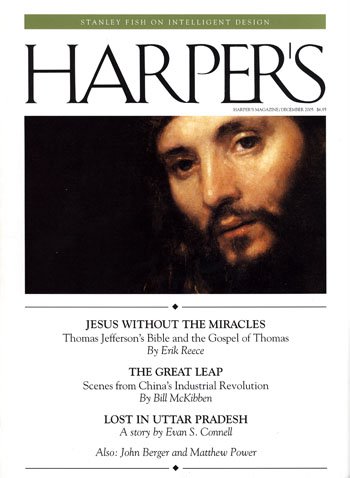
I've just had my spiritual inspiration for the week from an unexpected source: Harper's Magazine. The December issue contains two articles I can highly recommend.

First is the cover story, "Jesus Without the Miracles," in which Eric Reese draws a fascinating parallel between Thomas Jefferson's Bible and the recently unearthed Gospel According to Thomas.

Jefferson, as a private amusement, literally took a pair of scissors to the Bible and over the course of "a few evenings" (amazing what there was time for before TV) extracted the actual teachings of Jesus from the encrustations of story and myth that grew up around them in later centuries. The result was something similar to the legendary source for the Gospels that was thought to have been lost. In it, according to Reese, "Jesus never performs a miracle and never claims that he will have to die for the sins of humankind." Instead we are left with the record of his teaching, a stream of exhortations for us to love one another, to do no harm, to "become as passers-by," to live gently on the earth.

Amazingly, even as Jefferson was working on his piece of clip-art, the actual source material was sleeping soundly in a clay jar beneath the sands of Egypt. When it was literally unearthed in the 20th century, after two thousand years, and the fragile scraps of papyrus were deciphered, the document revealed a remarkably similar teaching, full of parables and Zen koan-like puzzles, and equally devoid of any talk of miracles or salvation.

Right off the bat, for example, one of the first of these "sayings of Jesus" goes like this: "Let him who seeks continue seeking until he finds, and when he finds he will be troubled, and when he has been troubled he will marvel, and he will reign over the All." Heady stuff, seeming to describe the feelings of a modern reader trying to make sense of all this, as well as the condition of spiritual seekers of all ages, and pointing the way toward the eternal.

The companion piece in the same issue of Harper's is a wonderful memoir by Scott Korb titled "All That I Have is Yours," which is what his stepfather told him on his death bed, and also a quotation from the story of the prodigal son. That story is so well known it is easy to overlook its significance, but something about the immediacy of Korb's retelling brought it home to me in a new way.

As you may recall, the whole thing began with the younger son insisting on having his share of the inheritance right away, so his father obliged by dividing the estate and giving him half, which he promptly went away to squander. When he reappears later, destitute, the father not only welcomes him in great joy but throws him a big party and even kills the fatted calf in his honor. Seeing this, the elder brother says, "Um, excuse me, but I'm still here, I've never asked for anything, I've stayed by your side as a dutiful son, and now he comes back and you kill the fatted calf for him?"

The father replies that they have to celebrate their joy, that their son and brother who was as if dead has returned to them. But more than that, he reminds him, "everything I have is yours." In other words, you already have everything there is, what more could you want? In the larger context of the parable, in which God is the father, we are reminded that we already have everything there is, that we inherited it at birth--an entire world, a whole universe that grows in size and richness the more we learn of it--and that all we have to do in return is to share it with one another. What more could we want than everything there is?

The personal nature of this great gift appeals to the Quaker in me. It is something we all share simply by virtue of our humanity, with no need for salvation or the mediation of saints and priests on our behalf. Jesus was trying his best to tell us, "you're already saved, you already live in heaven, what more could you possibly want?" But, as he is also reported to have said, ruefully I suspect, "unless you see signs and wonders, you will not believe."

Personally, I think the survival of these words and the record of them is plenty in the way of miracles. And I'll be happy to take this day, this world, this one universe, as the plenty that it is, and say, "Thank you, thank you very much, this will do nicely."