-->
Showing posts with label space. Show all posts

Wednesday, April 13, 2011

A Man in Space

So what were YOU doing that year?

In April of 1961 I had just turned 14 and was entering a phase of historical and political global consciousness. I was caught up in the ideological struggle of the Cold War, and I was also a science fiction nerd who avidly followed developments in rocketry and space exploration.

Every day as soon as I got home from school I spread out on the floor the morning Herald that had been carefully re-folded by my grandmother, and read through all the stories that I found interesting, which were a lot of them. I prided myself on knowing the names of the Presidents, Premiers, and Prime Ministers of foreign countries, as well as being aware of the many fronts where the forces of Communism and Capitalism were facing off.

But on April 12th I didn't have to go any further than the front page, where the smiling image of Yuri Gagarin announced that those durned Russians had beat us again. Sputnik had been bad enough. Only four years earlier we'd all been amazed when the first demonstation of orbital flight had been acheived without warning, like a premonition of the kind of nuclear sneak attack that we lived in fear of.

After excitedly following the ironically named American effort, "Vanguard," I had a vested interest in its success. I felt personally shamed when "our" rocket was not only beaten to the punch but then blew itself up on the launch pad -- not once, but twice. Before Dr. Von Braun and his Army missile team from Alabama managed to put something up there (Explorer I), the Russians had launched a second satellite containing the first living organism to travel in space -- Laika, the dog -- in a 13-foot-long capsule that dwarfed anything the US would be capable of launching for years to come.

In the four years that followed, the Mercury program was put into high gear. America had astronauts in training, a batch of test pilots with "the right stuff" to fly the US into space. In 1961 the first sub-orbital test flights were to be made using the same Redstone rocket that had put up Explorer I. Meanwhile the Atlas ICBM was being tested as an orbital booster -- with a disconcerting record of its own explosive failures. And then ...

Gagarin. It was Sputnik all over again. Before Alan Sheppard could take his 15-minute peek into space, Gagarin's one-orbit flight was followed by Titov's of 17 orbits -- a full day in which he travelled over most of the entire planet.

It all sounds so quaint now, and hard to understand why we took it so seriously. What we were witnessing was the first baby steps to be taken on our inevitable journey as a species into a wider environment. Now, along with our Russian (no longer Soviet) friends, we can celebrate the daring and achievement of all those pioneers, not just the ones of our own nationality.

Oddly enough, if I could pluck my 14-year-old self out of that past and whisk him into my present, it would not be the state of space exploration that would amaze him. Given the rapid advancement from Sputnik to Cosmonaut, he would probably expect us to have not only a space station but permanent bases on the moon and maybe even Mars by now. He would be surprised at the way we lost interest in the moon after visiting it a few times, and how we have backed away from larger challenges. He would be suitably impressed by the space shuttle, but puzzled to learn how old the design is, and that it has yet to be replaced by something newer and sleeker.

He would be impressed too at the advances that have been made with computers, lasers, and astronomy. Video conferencing, cell phones, and 3D televisions would be science fiction dreams come true. Electric cars -- OK, but no flying ones yet? What would absolutely knock him out, though, is the demise of the Soviet Union.

That thoughtful and tentative youth -- the same one who was going to have to deal one way or another with the military draft and the Vietnam war only six years in his future -- expected that the USSR would be there throughout his lifetime, and that it would continue to threaten nuclear Armageddon perhaps for centuries to come. He would have thought that if a lasting peace agreement were ever to be reached, it would be an agreement with the Soviet government.

All of which goes to show that it is usually easier to predict technological progress than social revolution. Witness what happened in the American colonies, or what's going on right now throughout the Middle East. Sure, we're still moving into space. But what will really happen to us is bound to be far more interesting ... and unexpected.

Tuesday, August 03, 2010

Future Past

Cookie, shmookie -- there's nothing like old music to evoke old memories ...

Remember Monty Python's "Summarize Proust" sketch? It was a quiz show in which contestants were given 30 seconds to summarize Marcel Proust's monumental Remembrance of Things Past. It went something like this:

"Go!"
"Well, um um, there's this man, um, and he's sitting -- he's sitting in a garden -- Oh! and there's a cookie! Yes yes, the cookie's very important, because, um um --"
BZZT!
"Time's up!"

But seriously ... The flavor of a cookie might have worked for Proust, bringing back the entire flavor of his childhood. But for me there's nothing better than hearing a piece of music I haven't heard for a long time. Recently I unearthed another lost recording that dates back (I'm amazed to say) almost 50 years. If you have any idea of my taste in music, you'll be surprised to hear that this treasured work is a collection of pop orchestrations by Les Baxter, one of those composer/arrangers who used to fill offices and department stores with "easy listening" Muzak.

I always thought that expression was perfect -- "easy" because it was so undemanding on listeners that you could hear it almost without noticing. To Baxter's credit, he was among the most capable practitioners of this style. At his best he approached the interesting orchestral textures of Ferde Grofé in The Grand Canyon Suite, and you could certainly stack him up against Leroy Anderson, whose work gets performed by serious orchestras.

So what's so special about Space Escapade? Well, to begin with, I was young and my musical sophistication had yet to develop. At the time the records in our household ranged from classical to Broadway musicals, but there was no jazz, no folk, and certainly no rock and roll. (Yes, kids, before it was Rock there was a roll at the end of it.) I think the only recordings I owned myself were Alvin and the Chipmunks (the originals) and maybe a Bob Newhart comedy album.

But I was enchanted with science fiction and Outer Space. And my dad had this wild friend who drove a Thunderbird sports car and threw parties. I'm pretty sure Space Escapade was a present from him, because my parents would never have bought such a thing. At any rate I always associated it with a free life style. Probably this was due to the cover, which represented some futuristic singles whooping it up with purple beverages and a misty floor. Things in the future would be more open and free, it implied. Girls would come in colors, like shirts, and there would be more than one of them available per male. (Hey, I never said it was politically correct.) Small wonder that it captured my juvenile fancy.

Looking for more info on Les Baxter I came across the website SpaceAgePop.com, the author of which has identified an entire genre of related music dating from the 1940's through the 1970's. One interesting thing to note is that apparently the "Space Age" is long since over -- it ended with the conclusion of the Space Race with the Soviet Union and the abandonment of the Apollo moon program. But for a few glorious decades the future seemed to hold unlimited promise. It was going to be a Technicolor future, with Americans riding in rockets to the accompaniment of sugary sweet violins ... a Jetsons future in which the nuclear family would consist of mom and dad, two kids, a dog and a robot.

Alas, that future is over too. It ended in the quicksand of Vietnam, the debacle of Watergate, two space shuttle disasters, financial collapse, terrorism, pollution, and the advent of global warming. We have to work quite a bit harder now to imagine a brighter future, and even then it is one that has lost its innocence.

But Space Age Pop is still here to remind us of the future that used to be. It even includes multiple sub-genres such as Exotica, Jet Set Pop, Incredibly Strange Music, and my personal favorite: Bachelor Pad Pop. Actually I learned later that my dad's wild friend was gay, so we really should add an additional genre called Gay Bachelor Pad Pop.

You can listen to samples of Space Escapade and the rest of Baxter's prolific output at Amazon. What's that? You say it sounds dippy? Of course it's dippy! That's the whole point! You just have to strap on your jet pack and go along for the ride. Even the album cover description is camp beyond words:
"Even today, in an era of science and satellites, the mystery of the universe has lost none of its magical appeal. We can close our eyes and dream of the future, wondering whether a starlit planet might soon replace a tropical island, the Riviera, or a distant mountain lodge as the ideal spot for a romantic holiday. Or, with the aid of the music in this album, we can drift into the future's lovemist with Les Baxter and make a spaceliner escapade by earthlight, tongue safely fastened in cheek."

Thursday, February 04, 2010

Back 2 Space

Let's see what the tea leaves have to say ...

Since back before the turn of the century (I know, that used to mean about a hundred years ago, but now it's only ten) I've been dabbling with predicting the future, so it's about time for a reality check. How am I doing, anyway?

Well, last January I dared to speculate on what the first year of the Obama administration might look like, and I can now claim to have been correct about two of the most wild leaps of fancy. First, on the financial front, I said: "By year's end financial experts will begin noting with some surprise that the stock markets have actually had a pretty good year. All those who waited too long to get out will suddenly realize they have waited too long to get back in."

Within weeks of this pronouncement the Dow began a plunge of over 1,000 points, and even the most optimistic investors would have been justified in having serious qualms about the rest of the year. Nevertheless, by December 31 the market had not only recovered the loss but ended around 30% higher than at the start of the year. Not bad!

What's that? You'd like to get in on a return of 30%? Sorry, too late. They tell us that the last time the market did that well two years in a row was at the beginning of FDR's first term. But remember, that was coming off the crash of '29 and it was a Depression, while what we had in '08 was merely a [subliminal: worst in our history since the Great Depression] "Recession."

The other limb I went out on was to predict a major shift in the role of NASA, with spacecraft development and operations being farmed out to private corporations. This new policy has just been announced, as reported in Astronomy magazine, following another one of the Obama administration's exhaustive reviews in which they actually tried to find out what was the best thing to do.

Return with us now to those thrilling early years of the airplane, where the likes of Charles Lindberg, Amelia Earhart, and Howard Hughes blazed new trails. Now it's time for the airlines to become spacelines, and for free enterprise to figure out how to finance our move into the wider solar system and beyond. Don't be surprised when the Chinese get to the moon and start mining operations, or some private venture decides to move mineral-rich asteroids into Earth orbit where they can be chopped up and refined into raw materials. We have passed the era of Columbus and Magellan. Now it's time for the East India Company to reap the rewards, and for the colonists to create the societies and interplanetary nations of the future.

Stay tuned for further developments.
[And check out this slide show to get an idea of how many players are already getting into this game: http://news.zdnet.com/2346-9595_22-390897-1.html?tag=content;col1]

Friday, September 30, 2005

Another Space Race


So we're going back to the moon, maybe even Mars. How come we're not excited about it?

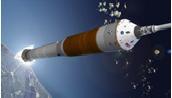
Could be it has something to do with NASA's recently unveiled designs for the vehicles that will replace the shuttle and be able to do all this. Not that they won't work, or that they aren't a wonderful exercise in practicality and utility. It's just that they're not, well ... sexy.

To a public jaded by the racy designs of Star Wars and other sci-fi epics, the new plans seem so pedestrian, with a bit of a retro flare. The capsule on top--right, a capsule--harks back to the original designs of the Mercury, Gemini and Apollo programs, and those are up to forty years old. The lunar landing arrangement is merely a souped-up Apollo with LEM variation. And the basic earth-to-orbit design, a pencil with an eraser on top, most closely resembles the original Mercury/Redstone sub-orbital hardware. Even the landing method--parachutes and airbags--seems a let down after watching those shuttle landings that can only be termed, appropriately enough, "death defying."

On one hand, we should be glad to see our tax dollars being spent in as economical a way as possible, given the task. On the other hand, it is an admission that the whole space-plane concept of the shuttle was a mistake, or at least an idea ahead of its time. But it feels as if, at the end of World War II, with the existence of buzz-bombs and V-2 rockets well known, the government had announced its plan to build a new and improved biplane instead of trying to break the sound barrier.

The very idea that we have not been back to the moon in thirty years is enough to make you wonder what we've been up to. If, instead of squandering all our money on shuttle development and two space stations of dubious utility (letting the first one, Skylab, burn up in the atmosphere for lack of funding), suppose we had continued to fund the existing Apollo program for all that time. Plans had already been made to add an extra stage to the Saturn V through orbital rendezvous, which would have made it possible to land enormous payloads on the moon. We might have had a thriving lunar colony by the 1980's for a fraction of what it will cost us now. Instead, as soon as the "moon race" was won, we lost interest and shut the project down.

Maybe a new space race is what we need to spur the technological development process. We already have plenty of competition from Europe and Japan when it comes to launching commercial satellites with disposable rockets. And Burt Rutan is showing us what private companies can do with a little financial incentive. (When he builds a space plane, it looks like one.)

All that's missing is the kind of rivalry that put national prestige on the line during the Cold War, and it looks like the Chinese are about to provide that. By calmly following their own timetable, and pretty much ignoring what the US, Europe and Russia are up to in space, it won't be long before they provide us with the kind of surprise that the first sputnik gave us. And if that gets us moving again, so much the better.

Tuesday, September 27, 2005

Cosmic Perspectives, Part 2: Voyager


The second thing that captured my imagination this week was the report that Voyager 1 has entered the next stage of its departure from our solar system by crossing the "termination shock" that marks the beginning of the "heliopause."

It's wonderful the way we find these new structures wherever we look, and the edge of the solar system is no exception. You might have thought that waving bye-bye to Neptune and Pluto would mark the probe's entry into empty interstellar space, but it turns out there is a detectable bubble of particles blown out by the sun, and a form of shock wave where the particles slow down from millions of miles per hour to radically slower speeds--maybe even reversing direction back toward the sun like waves lapping on a cosmic beach. This fuzzy line marks the region where the pressure of particles blowing in from other stars becomes more powerful than that of our own sun. Only when it travels beyond this region, which will take another few years, will Voyager enter true interstellar space and become our first probe to the stars.

Voyager wasn't the first vehicle to officially leave the solar system. In 1983 Pioneer 10 first passed the orbit of Neptune while it was temporarily the most distant planet from the sun due to Pluto's eccentric orbit. At the time NASA broadcast its bleeping radio transmissions to mark the event. There was even a toll-free number you could call to hear it live, 24-hours a day. (Had there been an Internet at the time, it would have been online as well, but the Internet had yet to develop.) And yes, I dialed that number and listened.

But Voyager is moving faster, and in 1998 it surpassed Pioneer 10 as the most distant man-made object.

More years have passed, and Voyager is still in the process of leaving. The boundary is that wide. The mission is thirty years old, and the probe may continue to function for another ten or fifteen years. It is now over eight billion miles out--twice the distance to Pluto--and by the time it expires it will be out over ten billion miles. But that will be only two-tenths of one percent of a lightyear, and the nearest star is over four lightyears away, and in a different direction.

Even so, I find this more exciting than anything that has happened in space exploration since the manned moon landings. (More on them another time.) As someone who has grown up through the era of rocketry, I have followed it since I was a small child, when Werner Von Braun and his team of German scientists founded the US missile program, and later the space program. I used to have a scrapbook filled with every photo I could find of rockets and satellites. I even kept a log as each satellite and space probe was launched, giving it up as hopeless when the launches reached into the hundreds (now thousands).

There have been many firsts over the years. Some of them were significant: the first satellite in orbit, the first human in space, first probes to the moon and other planets, first people to visit the moon. Others were merely of passing social interest, or of concern in the "space race" between the USA and the USSR: the first woman, first "space walk," first orbital rendezvous, or the first [insert your nationality here] in space.

There will be other such firsts as we venture forth from our planetary home. And there may be other "space races" in our future--are you watching the Chinese? But there will always be Voyager 1, this first tendril of human construction, a mere bucket of bolts, drifting out among the stars like a bottle in the ocean, bearing a message in case it ever washes up on some far shore, a message that says, "we were here," and which may be read when the human race is no more than an archeological relic.

Saturday, September 24, 2005

Cosmic Perspectives, Part 1: Distant Light


During the course of my own brief lifetime, a mere half century or so, the universe has aged quite a bit. Of course, that is only in our perception of it, which has also undergone quite a bit of revision in recent years.

When I was a kid, the age of the earth had been pegged pretty accurately at around four billion years--quite a difference from the Biblical estimates of four thousand (only a small fraction of human history). The rest of the universe was thought to be somewhat older, but perhaps not more than double that figure, or around eight billion years. Gradually, astronomers refined the figure upward till it exceeded ten billion. But the aging process didn't stop there. Current estimates range from eleven to as high as twenty billion years. (To get some idea of how the calculations are done, check this out, or Google the age of the universe.) The estimates vary so widely because there is still so much we don't know, such as how much "dark" matter and energy is out there--the existence of which was only recently discovered.

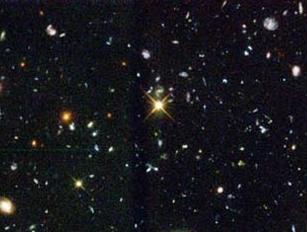
Normally most of us don't think about all this very much, except while watching an episode of Nova on PBS. But the other day something brought it all home to me in a new way. It was reported that astronomers had detected the explosion of a star twelve billion light-years distant--meaning, of course, that the explosion happened twelve billion years in the past, and the news of the event, traveling at the speed of light, has only now arrived.

It's one thing to consider millions of galaxies being that far away, but there was something peculiarly nostalgic and evocative about one particular individual star being singled out over such a huge distance. I felt as if a window to the past had suddenly opened, leaving me gazing across this vast stretch of space and time the way Gatsby stared across his lake at the dim beacon that marked the home of his lost and unattainable love.

So, twelve billion years ... the place is at least that old--older, because the star had already formed and burned for at least some millions of years before it blew up. And it is at least that large in all directions from here. Does that mean it's twice twelve billion? Or even larger/older? Or is that just a trick of perspective, due to space itself being curved?

Maybe, in the fullness of time, we will have lifted our heads high enough to see beyond the cosmic horizon, and know the answer. Until then, let this lonely beacon be a sign to us of all we have learned, and all we have yet to learn.