


 Posts
Posts


The further we look, the bigger it gets ...
In Annie Hall, Woody Allen portrayed himself as a child who stopped doing his homework when he heard that the universe was expanding. "What's the point?" he asked. Then his mother told him it was none of his business, because, "Brooklyn is not expanding!" Regardless of the relative stability of our local environment here in our hometown Milky Way galaxy, we have every right to be concerned about the size and shape and age of the universe as a whole. After all, its origin is the origin of all of us, and its fate will be ours as well. Who would not want to know the answer to the question, "is the universe infinite, or just very very big?" Or the related one -- "does it have a beginning and an end, or does it last forever?"
Last year I wrote about how the universe has aged during my own lifetime -- meaning, of course, that our knowledge of it has grown, and our estimates of its age have been continually refined in the light of new observations from both astronomers and quantum physicists. Fascinatingly enough, the contributions from those who study the very large and the very small have contributed equally to the latest theories of how the universe began and where it is going. But sometimes it seems as if it keeps getting bigger every time we think we've seen the end of it.
Since the first half of the 20th century it has been known that the universe, however big it is now, is getting bigger. All the galaxies are apparently rushing apart from each other as the space between them stretches like a balloon -- a process that has been going on since the Beginning.
When I was very young, there were two contending theories: the Steady State universe favored by Einstein, in which new matter and energy were continually created to replace those that are lost, and the Big Bang universe, in which everything was created in a single explosion. Since the 1970's, when it was discovered that we could directly observe the background radiation left over from the Big Bang, that theory has been generally accepted. But as scientists have continued to refine the theory and explore its consequences, some serious problems and implications have come up which have cast doubt on it.
In their new book, Endless Universe: Beyond the Big Bang, Paul Steinhardt and Neil Turok have taken time out from their serious work on the subject to write an explanation for laymen of their alternative theory, which they call the Cyclic Model -- actually a new variant of an older idea. (They even have a website at endlessuniverse.net with animations.)
They begin by leading us through the development of the Big Bang model, and showing how it has been added to and modified in an attempt to incorporate the latest, often contradictory, findings. One of the key issues is about expansion, and whether it will end or just keep going forever. It used to be thought that this was just a question of how much matter there was in the universe, and whether the gravitational force of it would be enough to slow the expansion down. In this case we could eventually expect a "Big Crunch" where everything converges into a single point again and creates a new Bang.
I confess this picture always appealed to me. It was so similar to the Vedantic idea of a cosmos that "breathes in and out," and is repeatedly created and destroyed. But measurements showed there was not enough matter to explain why the galaxies were not rushing apart even faster than they are. Then "dark matter" was postulated and proved to exist -- in fact, it was eventually shown that as much as 95% of the matter in the universe is of the "dark" variety: not visible, but deducible by its gravitational effect on the kind we can see. It was concentrations of dark matter that caused the galaxies to form.
For a time it looked like dark matter would keep the universe from flying apart, and would be enough to bring it back together for another round of Bang and expansion. But new measurements have shown that not only is the expansion not slowing down, it is actually accelerating in spite of all the dark matter. So now "dark energy" has been assumed to be present also -- an anti-gravity force that inevitably comes to dominate the universe when it gets dispersed enough, and appears to make expansion continue forever.
There was another hope for a finite universe: the idea that space and time might be curved, as predicted by Einstein's theory. In this model the expansion might continue, but space might be curved like the surface of a sphere, or some more complex shape, so that it would turn back on itself eventually. I picture this like a Big Bang starting at the north pole and expanding all the way to the equator, at which point it would contract to the south pole and create a new Bang there.
But these hopes, too, have been dashed by further observations that have shown that the universe, regardless of the possibility of curvature, is in fact "flat," though no one can explain why. The disturbing result is a universe that achieves a livable condition for only a short time, cosmically speaking, during which stars and planets like ours can exist, but which then continues to spread out and dissipate until all the matter and energy has wasted away to nothing, leaving only an endless and perfect vacuum of non-being.
Even worse, the theory has been found to imply that there may be an infinite number of "pocket" universes lost in an infinite sea of nothingness -- and furthermore, most of them may be lifeless ones in which the balance of natural laws are not conducive to stars and galaxies, or even matter as we know it, let alone anything resembling a human being. Ours could be the only one of its kind, produced by a random fluke, and once it burns out like a dying flame it will be gone forever.
Help! Are we doomed? Is this terminal nothingness all we can look forward to, regardless of how long it takes to get there? Can you see why Woody Allen might give up doing his homework?
The Cyclic Model is a possible salvation from this dismal picture. Though it may not be proved conclusively for some years yet, it apparently resolves many of the mathematical and theoretical problems of the Big Bang model, while completely agreeing with it as far as the current state of things as we can observe them. The difference is that it supposes an endless series of creations and expansions, and offers a mechanism to explain how they work-- and even why space becomes flat. In this view, the universe still ends up nearly void, but that is part of a process that brings it into collision with a parallel universe, a kind of doppelganger with which it is intimately bound, and this collision generates the energy for a new beginning.
I cannot pretend to understand the process that has led them to this conclusion. That would require an ability to do the math--though the authors do a commendable job of presenting it in a way that can be logically followed. But for me it is enough to be able once again to believe in a universe that comes and goes, but continues; one that has been here before, and will be here again.
Don't we all yearn to be immortal? As individuals, we may never be. But as parts of this endless and expanding series of universes, perhaps we already are.
Showing posts with label universe. Show all posts
Showing posts with label universe. Show all posts
Saturday, May 10, 2008
The Mind-Expanding Universe


Saturday, September 24, 2005
Cosmic Perspectives, Part 1: Distant Light
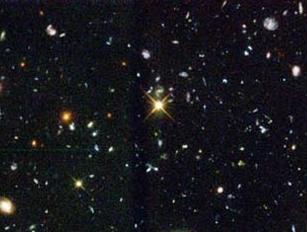
When I was a kid, the age of the earth had been pegged pretty accurately at around four billion years--quite a difference from the Biblical estimates of four thousand (only a small fraction of human history). The rest of the universe was thought to be somewhat older, but perhaps not more than double that figure, or around eight billion years. Gradually, astronomers refined the figure upward till it exceeded ten billion. But the aging process didn't stop there. Current estimates range from eleven to as high as twenty billion years. (To get some idea of how the calculations are done, check this out, or Google the age of the universe.) The estimates vary so widely because there is still so much we don't know, such as how much "dark" matter and energy is out there--the existence of which was only recently discovered.
Normally most of us don't think about all this very much, except while watching an episode of Nova on PBS. But the other day something brought it all home to me in a new way. It was reported that astronomers had detected the explosion of a star twelve billion light-years distant--meaning, of course, that the explosion happened twelve billion years in the past, and the news of the event, traveling at the speed of light, has only now arrived.
It's one thing to consider millions of galaxies being that far away, but there was something peculiarly nostalgic and evocative about one particular individual star being singled out over such a huge distance. I felt as if a window to the past had suddenly opened, leaving me gazing across this vast stretch of space and time the way Gatsby stared across his lake at the dim beacon that marked the home of his lost and unattainable love.
So, twelve billion years ... the place is at least that old--older, because the star had already formed and burned for at least some millions of years before it blew up. And it is at least that large in all directions from here. Does that mean it's twice twelve billion? Or even larger/older? Or is that just a trick of perspective, due to space itself being curved?
Maybe, in the fullness of time, we will have lifted our heads high enough to see beyond the cosmic horizon, and know the answer. Until then, let this lonely beacon be a sign to us of all we have learned, and all we have yet to learn.
Subscribe to:
Posts (Atom)