-->
Showing posts with label writing. Show all posts

Saturday, March 05, 2016

Writing In The Clouds

We interrupt this novel in progress to bring you a word from our sponsor ...

Ever since I traded my little netbook for a Chromebook I've been experiencing an interesting migration. Mostly I'm happy with the Google cloud-based computer. It boots in 30 seconds, shuts down in about 3. (Don't you wonder why it takes Windows PCs so long to turn off? What are they doing?) The only time I've been aware of the invisible updates is when I noticed a tiny text message in the lower right corner that said softly, "Reboot to finish update." And I have never had to bide my time while staring at a screen warning me not to turn off my computer.

The adjustment came when I tried to determine the best way to use this as a writing machine, which is its main purpose in my life. I like writing on my desktop, too, but sometimes there's nothing like a comfy chair and a lap full of keys. Not to mention travel.

First thing I did, being an inveterate geek, was to use Crouton to install a full Linux system under the hood. Lots of online guides make this a pretty simple process. You still start up in Chrome's online world, but with a few keystrokes you can boot into a full Linux desktop. The only disappointment in my case was that I have not been able to get one of the features to work. You're supposed to be able to quickly flip back and forth between the two environments, but it doesn't happen on my HP. Not a big thing, though, since if I go into Linux I expect to stay there.

The Dropbox Snag

As I did with my netbook before, this let me install LibreOffice for document editing. Then I hit my first snag. I use Dropbox to make my documents available to me everywhere, but the HP has an Nvidia Tegra Arm processor -- and Dropbox, though it supports Linux, does not have a Linux client that runs on Arm chips. This meant I had to start out in Chrome, copy whatever files I wanted to edit into the Download folder which is also available when running Linux, then start Linux and open them from there.

A similar process would have been needed to copy the modified files back to Dropbox, but clearly this whole exercise would have seemed more trouble than it was worth. Someone has written some command line tools to do one-time Dropbox syncs in this situation, but I didn't care for that either.

Back in Chrome, there is support for Dropbox through a third-party app that integrates it into the file manager. The files are not synced to the SSD drive on the Chromebook, which would quickly eat up the limited space, but you can find your files and copy them or open them. Editing apps don't seem to be able to write directly to Dropbox, however, so you still have to save them to the Download folder, then copy them from the file manager.

What To Do?

Mentally kicking myself for not discovering this shortcoming in advance (and making a mental note to choose one with an Intel processor next time), I set out to explore my alternatives. Google, of course, would love for me to use their Docs suite for everything, and to save it all in Google Drive. But I've never been happy with the way Drive pushes you toward Docs, and vice versa. If Microsoft were in that driver's seat I'd be equally displeased. But they've actually done a better job at openness with OneDrive. And Docs is woefully lacking in formatting features, even for something as simple as fiction.

I played around with editing some of my Open Document text files (.odt) in Docs. You can do it, but it requires you to upload your file to Drive first. If you're trying to start a new Doc you can only do it in Google's own format. If you want to convert it so you can edit with LibreOffice too, you have to Download As .odt and save it back to your Drive, which is available in the file menu, then open that version of it. Are you kidding me? I think there used to be a Save As option that would let you change the format of the original file, but it's been removed.

With Docs eliminated, and still favoring Dropbox for storage, I looked for alternatives and found two options.

ZOHO To The Rescue

Zoho Office, a project started in India, was my first choice. It has a much more full set of editing features, including the ability to save named style sheets. It has Dropbox integration built in, though the free version (yes, it's free) is limited to syncing only a single folder with no subfolders. It will edit Open Document formats and save them as such. If you're creating a new document, you still have to do Export As, but you can save it directly to your shared Dropbox folder and then continue editing it there.

About the best endorsement I can offer Zoho is that I quickly went from experimenting to writing. I forgot entirely about what tool I was using and entered into creative work. And isn't that what good tools do? They disappear, and let you get something productive done.

The only glitch I found was the first time I went into Dropbox on my desktop and discovered 187 versions of the chapter I'd been editing. Apparently Zoho automatically saves every sixty seconds, and Dropbox treats each one as a new version. But I found there is a choice to do one-time syncs to Dropbox, and that alleviates the replication issue.

Zoho also offers their own cloud storage that will sync to your desktop, with 5 megabytes under the free plan. So if you're not wedded to Dropbox like I am, that might be an option. 

The OnlyOffice Route

I also explored OnlyOffice, which has a similar set of cloud based apps and storage. The initial attraction was the beautiful and complete Dropbox integration it offers. But there were downsides. You can edit Open Document files, but it has to convert them to Microsoft Office format for editing. There is an option to "also save in original format," but I didn't see any evidence that it did that when I selected it.

OnlyOffice uses HTML5 and Canvas to render your work on screen. While that sounds very hip and contemporary, I found it takes a long time to open and display anything. And on my Chromebook I couldn't find any resolution or zoom combination that would render the text in anything other than a fuzzy gray, which was intolerable. 

Anyone Else?

OnlyOffice has a 30 day free trial, but no free version. After that it costs $5 per user per month, with a minimum of two users. Do the math. Zoho has the free version, or you can upgrade for $5 per user per month, with no minimum. Combined with my pleasant user experience, I know which one I prefer.

We might well ask at this point, with Microsoft offering Office online, where are the LibreOffice developers and what are their intentions as everything moves to the cloud? At the moment, the only option is RollApp, which lets you run LibreOffice on a remote server -- as well as dozens of other open source apps like Gimp. There is a free version that offers read-only access to Dropbox. The paid version with read-write access is $7 per month, or $6 if paid annually. It sounds like a bargain compared to the option of just an office suite, but it seems a cumbersome way to go about it. And there's no way to use the apps offline since they're not really running on your own computer.

To Sum Up What We've Learned

Though some of this experience has been annoying and frustrating, it has demonstrated to me that the basic idea of the Chromebook is the future -- or the present, if you're already using one. With files in the cloud already, and an OS that updates from the cloud, why not apps in the cloud too? Increasingly, the bulk of what we do is destined for the online realm, and fully interdependent with it. 

Take this blog, for example -- composed entirely in Blogger, automatically saved and backed up so I won't lose anything, and instantly published everywhere. Excuse me a moment while I click the button...

Thursday, February 10, 2011

Cadillac Lady

Like two ships passing in broad daylight ...

I first spotted her when I began taking the train to work, which meant I had to walk the last few blocks to my office. I only  noticed because she was parked in a big black Cadillac, shiny and new, with the engine running. So that first impression symbolized American wealth and extravagance, idling a big V8 engine just to keep the sole occupant of the car comfortable in the heat.

As time went on I realized I was seeing her almost every day, parked in the same spot. It was right in front of a big picture framing store, so she might have been a wealthy patron having some of her art collection framed. But not even a museum would have enough work to keep her there day after day, and always so early in the morning.

It didn't take long for my writer's instincts to kick in. Part detective, part fantasist, that side of me filled in a picture. It had to be her store, her business, that she was keeping an eye on. Maybe her husband used to run it, but he's dead now, and she's in her old age, hanging on to what she has left. Naturally that means making sure the employees are on the job and not stealing from her, that the manager gets there and opens up on time.

She also has an obsession with protecting her parking lot. She's in a neighborhood with scarce public parking and numerous restaurants and night spots. Some business owners might hire a guy to rent out spaces at night, but she puts chains across the driveways and posts WILL TOW signs. When the chains are broken or taken down, she has thicker ones installed, with padlocks. When someone runs into them she has them painted yellow. When the posts are knocked down, a crew is at work the next day installing new ones.

I know the parking lot because I cut through it to save a few steps. At least I used to, before she had additional chains put up to seal off the pedestrian-sized openings that not even a motorcycle could have squeezed through.

Were those chains directed at me? Has she been watching me through the glass of her tinted windows, through a glass darkly, seeing me as a threat? I could jump the chains easily, but I don't. She'd only put up taller ones, like an athletic competition raising the high jump bar till only one person could clear it.

Instead I respect her boundaries, the territory of her own space that she guards so jealously, hands clutching the motionless steering wheel, driving nowhere, eyes behind sunglasses, a cigarette held in her lipsticked mouth as she gives herself a light and fills the hermetically sealed car with a cloud of her own smoke.

When I took her picture this morning, she silently drove away.

Tuesday, October 27, 2009

Taking the Plunge

A pause that refreshes ...


For some time now my friend Laura Cerwinske has been conducting classes in what she calls Radical Writing. Simply put, it's a technique for using writing to dig into what's up with yourself and to clear up the log jams that most of us experience as getting in our way as we try to navigate down the tumultuous river of life. (Lookout, matey -- thar be rapids up ahead!)

In a former incarnation, these classes were titled "Writing as a Healing Art," which is another good way to describe what happens in them. But lets face it, Radical Writing has more panache. It also captures something about the way you are supposed to launch into your assignments. This is not "creative" writing, or memoir, or even journal writing, though it may have elements of them all. More than anything it is "automatic" writing -- an attempt to let the words flow as uninterrupted as possible from as deep a source as possible, close to the unconscious itself.

This weekend I participated in a two-hour workshop with Laura, my wife, and several other acquaintances and strangers (no, they weren't so strange, only people we hadn't met yet). I thought I might share what came up for me as a way to give an example, so here goes ...

Our first task was to state why we were there:
"My intention for coming here today is to pass the time as pleasantly as possible while delving into some of the scarier parts of my internal nature and sharing them with a combination of intimate friends and complete strangers - an experience no doubt to be be fraught with qualms but which I am quite prepared to plunge into as if taking a dive off the high board - which I did once as a teenager."
At this point Laura pounces on everyone's hot spots and assigns a different task to each one. Mine was to revisit that plunge that I only took ONCE and never again.

"What it was like to look down at the water, so far so far below, and come to the brink and be afraid and do it anyway, the bang of the impact, glad I did but not ever going back for more - so what is the plunge now? not the old ones, the starting of a business, the selling of it, marriage and divorce and marriage again, the change of career - too late? too high? and the plunges yet to be - yet another career, more creations, more disasters, vortexing whirlpooling closer to the last disaster of all that awaits somewhere down the line - to plunge into life as if into death, to commit all, hold nothing back, to be all in the game, to be alive-dead, to be dead-alive, without any hope or dread."
And then a follow up: What if disaster does NOT lurk as a result of my plunge?

"In spite of my fear of rejection I submit my novel and the publisher despite some misgivings agrees to publish it and Oprah loves it as do her millions of viewers and the movie version collects Oscars for the director and cast and I start turning out sequels at the rate of one every 2 or 3 years while the royalties add up and my biggest concern is how to distribute all the money among various charities because my own needs and those of all my family are long since satisfied and I can go to my final rest knowing I have lived the life I was meant to live and given it everything I have and learned all there was to learn and done as much as I possibly could and have no regrets and no apologies to make and know that this is just about the most perfect way for things to be."
Now finally, as a sort of combination graduation exercise and final exam: What I'm feeling now:

"I'm able to breathe - a relaxed feeling in the chest and solar plexus - goes along with a feeling of standing straighter with my feet solidly on the ground, legs extended without slouching or stooping my shoulders, goes along with seeming to see more clearly and attentively - but breathing above all, drinking in the air like cool water, cleansing and life giving, healing, maybe blessing as in holy water, maybe flowing as in streams, cold mountain ones that melt from the glaciers or deep blue ones that melt from the polar ice, a feeling of melting, of thawing, as at the end of a freeze, a relaxing, a seeping into moist earth from which things can grow - and what might sprout, I wonder, what green shoots of dormant things might emerge - everything that has been buried and lost - everything of life that has been dormant and in hiding - out into the clear air - into the lungs and out again - merging with the vapors of the world by inhaling them, waking up from a dream."
Pretty cool, no? And don't worry that I've spilled the beans. If you should take the class (which you can also do online in the comfort of your own room) I guarantee your results will be completely different -- as mine would be if I did it again right now. Hmmm...
"My intention for being here tonight is ..."

Saturday, September 26, 2009

Enough Crime Fiction Already

How many ways are there to end up dead?

Don't get me wrong -- I enjoy a good detective story as much as anyone. And the genre's prolific practitioners, from Edgar Allan Poe to Arthur Conan Doyle, Dashiell Hammett, Raymond Chandler, Jim Thompson and many more, have left us some wonderful works. But it seems to me we may have exhausted the possibilities of inventing new and ever more bizarre ways for people to be murdered. I don't doubt we can keep it up, but I question whether the exercise is worthwhile. It may even be destructive.

This doesn't tarnish my admiration for the likes of Chandler. For example, one of the many times that his hero, Phillip Marlowe, wakes up after being knocked unconscious, what does he see? A beautiful woman of course. And what does he say when describing her? "A glass of beer stood tall and amber at her side."

Is that great writing, or what? It's a line that sings, a piece of iambic poetry that jumps off the page while bringing the woman into focus. She's elegant because she sips her beer from a tall glass. At the other end of the literary scale, Mickey Spillane's hard-boiled Mike Hammer would have said, "she had a beer next to her." Not the same thing at all.

But that's Chandler for you. He had a way of giving you the whole person or place with just a pair of details. So he calls forth an entire room by focussing on the single yellow rose in a vase atop the grand piano. Or the life of a gin-soaked old woman by noticing the dead fly trapped behind her window screen. It's a kind of writing with images that must even survive translation.

Unfortunately few of those who followed after have equaled Chandler in poetry or matched his chivalric sense of bringing order to the chaos of the unlawful. The public demand for more has called forth an endless stream of imitators, many of whom must qualify only as lesser talents. But if they can't write they can still dream up endless new variations on the demented criminal mind, with loads of ingenious ways for them to torture and kill their victims.

I confess I fell into this trap myself some years ago. Combining my fondness for Marlowe with an interest in Miami history, I invented a detective of my own named Jonathan Spare who came down here from New York in the 1930's on a manhunt and stayed. My original idea was to do something different with the genre. There was to be no murder, only a haunting kind of search in which the watcher found himself being watched.

But when I arrived at the end of the novel I was dismayed to find that three people were dead, and my hero had killed two of them himself. What happened? Two things, I think.

First, the genre makes demands of its own. When I was about two-thirds of the way through and trying to figure out how it should end, I realized my hero had to confront the evil he had uncovered. If he didn't, it just wouldn't be a story. And confronting it seemed to require doing battle with it, and since good must triumph the evil ones had to perish. Well, they had it coming, after all. And my hero had to be transformed by all this.

The second thing is that I fear the contemplation of these evil deeds must have an effect on the author. We have to imagine what we write to the point of living it. Whatever our characters are up to we have to be there with them and see it through their eyes. One wonders how Jim Thompson, for example, was able to live with himself after spending so much time closeted in the dark and cramped minds of his demonic, obsessive characters.

It reminds me of a story by Jorge Luis Borges where a wealthy man gives a big party. In his basement he has a museum of weapons that he has collected, and one of his prize pieces is the actual knife that was used in a notorious murder. Later, two inebriated guests go down to look at it and end up having an argument. You guessed it: one of them dies. The knife has struck again.

So too with the "mystery" novel. Nowadays there is less mystery in it, but ever more graphic and depraved violence. The audience demands it. The publishers demand it. The movies demand it. The characters and plot demand it. What's a poor writer to do?

In spite of all this, it is not impossible to transcend these demands and to create something truly marvelous. Look what Graham Greene did in The Third Man, where a man searching for his missing and presumed dead friend finds him very much alive, but having caused the deaths of untold numbers of innocent people by blackmarketing worthless medicines. Or his earlier Brighton Rock, in which an average woman rises to heroic stature as she makes it her business to bring a couple of thugs to justice.

More recently Denis Johnson's Resuscitation of a Hanged Man accomplished something like what I had in mind -- his hero, only a part-time detective, seems to end up hunting for himself in a wonderfully detailed and dreamlike archetypal fantasy.

I had an epiphany about all this one year at the Miami Book Fair when I attended a session called "Crime, Real and Imagined." The panel included two crime novelists, one of them a woman new to the field, the other a former NYPD officer. With them was Arthur Jay Harris, a reporter for the Sun Sentinel, who had just published Until Proven Innocent, an account of a real Broward County murder and the police detective who showed that the prime suspect was innocent of the crime.

What struck me about this presentation was the contrast between the ways murder was represented. In the fictional accounts the violence was exciting, and the tension leading up to it was titillating, almost sexual in intensity. The factual book began with the first visit to the crime scene, an ordinary house drenched in blood, and the understandable horror that comes over anyone who has to see such things.

I realized that only the real-life (or real-death) account elicited the normal reaction of disgust and revulsion that most of us have when we actually encounter violent acts. The fictional stories were just playing with the idea. There was no reality behind them, so they had to make up for that with senseless excesses.

That was the day I gave up on my fictional hero. Somewhere in his alternate reality he is free now to go his own way, to choose another profession, one that will not call upon him to become as evil as those he has to pursue. He won't have to go through all those other things I had planned for him in sequels. No hunting for fascists during World War II, no encounters with KKK racists, no agent provocateurs during the McCarthy communist witch hunts.

Maybe he'll sell real estate. That used to be a good business in Miami. He can buy a house himself, settle down, maybe get married and have a kid. He can have a life. And the rest of us can get on with ours.

Saturday, December 27, 2008

Number 52


A year ago I committed to publishing a new article on The Nort Spews each week. If I had thought about how many weeks there are in a year, and that it would mean writing 52 essays in that time, I might have chickened out. But here it is, a year later, and we have arrived at number 52.

Looking back, what surprises me most is that I was never at a loss for something to write about. Between books, movies, music, politics, religion, science, grandchildren, sports, and prognostication, there was no shortage of material. In fact, for most of the year I had several articles waiting to post well in advance of my Saturday deadlines. Of course, professional columnists do this all the time, year after year -- some of them with daily deadlines on top of the weekly ones. This experiment has given me new respect for them while at the same time satisfying my curiosity about my ability to get that kind of a job done. (Offers, anyone?)

But it has meant much more to me than that.The blog has given me both opportunity and incentive to more fully explore my own life of the mind. It's one thing to enjoy a piece of music, another to give expression to that enjoyment and share it with others. Life itself is full and rich, but much of the richness flows past all too quickly and is lost like flotsam in the wake of a boat. The blog has been a way to capture some of those things as they go by, to take snapshots and fasten them into an album of memory.

Blog writing is really a new form of communication, part diary, part editorial, part open letter to an intimate friend. In making my efforts public, I find I have a reason to explore my thoughts more fully than I would if I were merely making notes for my own reference, as I would in a journal, or even in a deep discussion with a close friend. Instead of just saying what I remember, I'm forced to check my facts, which is often an interesting exercise in itself. As Yogi Berra said, "You can see a lot just by looking."

And what a full year it was. Looking back over my list of titles I see that I began and ended with exploring the future, both in science fiction and fact. In "The God of the Falls" and "The Simple Truth" I managed to give as complete a statement of personal spiritual belief -- and history -- as I have ever done. It was the year I explored ebooks with the Sony reader I got last Christmas, opening a new torrent of readily available literature. I recorded another visit to the Miami Book Fair, and explained the secret behind my fondness for the Olympic Games. There are memorials to my father-in-law as well as to Alexander Solzhenitsyn, and reports on three notable Conscientious Objectors -- one of whom I met, and another who should be legendary.

I revisited the Evolution debate yet again, and explored a new theory about the origin and fate of the universe. I reviewed three 19th century books about America, three versions of The Man Who Would Be King, three books about Los Alamos, and two histories of the early U.S. Navy. I cheered on a Presidential candidate, and shared my vote with my eight-year-old grandson in an election that neither of us will ever forget. And always there was a backdrop of music ... the innovative computer animations of Animusic, the immortal pianist Glenn Gould, the history of local classical radio, and the lost jazz of Paul Desmond.

I'm under no delusions of fame for all this. Google's tracking software tells me I get some hits every day, but many are mere glances, like the passing eyes of browsers in a book store. There are a few faithful readers out there (you know who you are!) to whom I am grateful. Sometimes a comment comes back like the distant plunk of a pebble plumbing the depths of a deep well. But I am my own favorite reader, and the rewards of writing have never been more clear to me than they are now.

So onward into 2009. My challenge for the new year will be to keep it up without the clockwork of calendar deadlines. I may post more or less often than once per week, but life goes on, and so will these observances of it. I feel sure there is much more to come.

- Steve Donachie

Monday, November 21, 2005

A Day in the Life of the Book Fair


It's hard to believe, but I've been coming to the Miami Book Fair for 22 years, since it first began. During that time it rapidly matured from something that could have been a flash in the pan into the premier such event in the country.

Maybe it has something to do with publishers living in New York, which is growing grayer and colder by mid-November, while Miami is usually waiting for its first cool spell of the fall. But if it were only the weather, then surely mid-winter would be the time to insure the biggest draw.

Instead, what has insured the Fair's success is the maturing of community support. More than the existence of financial grants, it is the dedication of those who make it happen--people like Mitchell Kaplan, owner of Books&Books, our favorite area book store--and those who turn out in droves to attend the hundreds of readings it produces, not only on the weekend of the Street Fair but throughout the year.

The Book Fair plays no small part in supporting the community of writers in the region. Writers, both successful and aspiring, have an annual fountain of inspiration in their midst, a chance to see and hear and hang out with some of the most notable figures in print.

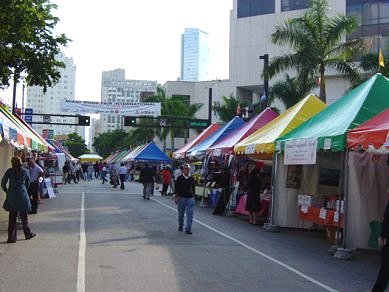
I long ago gave up trying to take it all in. It's not possible. The readings take place simultaneously in twelve different rooms ranging in size from the large auditorium that seats up to a thousand down to intimate classroom or gallery spaces--even, in the case of The Spoken Word Cafe, a tent. And they last from 10 am to past 5 pm. Even if you don't eat (and who can pass up the opportunity to purchase overpriced fair food washed down with a five-dollar lemonade?) and even if you try to limit yourself to the things that interest you most, there are still schedule conflicts that force you to make tough choices, or to duck out of the question session at the end of one reading and sneak into the middle of another one already in progress. On top of that, you have to find at least a little time to do some book shopping in the stalls on the street.

But then, that's the fun of it. For a reader, the chance to wallow in readings of this quality, so plentiful that you can't do them all, amid heaps and stacks and racks full of books, is a feast that naturally belongs where it is on the calendar, right before Thanksgiving.

Just to give you a taste, here's how my own choices ran this year:

Saturday

We arrived late but still caught the second of two travelogs. Elliot Hester, a native Miamian who spent a year making his way around the world, has written Adventures of a Continental Drifter. He entertained us with a tale about the night he was nearly beaten to a pulp by the martial arts bouncers in a tourist trap in Bangkok, saved only by his remote resemblance to boxer Mike Tyson. A lot more fun to hear about than to live through!

11:30 found us basking in the warm rays of Carribean culture. Robert Antoni took us through an all-night muddy bash during Carnival in Trinidad--enough to make you want a shower by the time he was done.

Then Pablo Medina shifted gears to the complete introspection of his cigar-maker invalid, a transplant from Cuba to Ybor City (near Tampa) where he was felled by a stroke and turned into a bed-ridden patient, unable to move. I've never heard such material so vividly portrayed since I read Dalton Trumbo's Johnny Got His Gun, about a more horrifically afflicted veteran of World War I.

Finally Marlon James captivated us with his gossiping old Jamaican ladies and an account of how the "Rum Preacher" came to a bad end. As they say in the islands, "soon come, mon."

At 12:30 it was time to do politics. We sat in on George Packer's presentation on The Assassin's Gate, his study of how things are going in Iraq (the short version: not well). Hard to believe there has been enough time for him to research and write on this subject while it is still unfolding daily, but his interviews with people "on the ground," as opposed to those in high places, have yielded rich fruit.

The other member of this panel (David Rieff had to cancel) was Jonathan Ralston Reid, a Canadian who has written The Collapse of Globalism. This is not something he's predicting, but something which has already happened, according to his interpretation. All the promises of the "new world order" having failed, with the opposite results all around us, does make it look as if the emperor paid too much for those invisible clothes.

I'm pleased to be able to count some of the authors as friends and mentors. After lunch we had poetry for dessert at the reading of James Brock (friend), Michael Hettich (maybe not quite friend but certainly acquaintance), and Campbell McGrath (closer to the mentor category since my workshop with him at the Seaside Writer's Conference). It was good to note how "friendly" these differing voices were with one another. And always a pleasure to listen to.

[An example of schedule conflict here -- one of our friends was notably absent because she just HAD to see novelist Amy Tan, currently appearing in another building.]

But we weren't done yet. At 4 p.m. we heard Bruce Feiler on Where God Was Born. Feiler is personally exploring the historical landscape of the Bible, visiting such places as the Garden of Eden (currently paved). His earlier work, Walking the Bible, will soon make an appearance as a Public TV documentary series. Consult your local listings.

Also on this panel was former poet laureate Robert Pinsky, who has written a scholarly Life of David. Most memorable for me in his presentation was the description of what happened to the Israelites after they arrived in the Promised Land. Miffed at the way they behaved, the vindictive God that they had back then arranged for an army to come in and move them back out. The lesson in this was that the important, essential thing was not having a nation, or a temple, or even a rabbi or priest, but that every person would have their own relationship with God. It was a maturing of the concept of religion, and emphasized that religious experience was directly available to each individual.

Sherwin B. Nuland was the final participant in this session, and introduced me to someone I was ignorant of: Maimonides, a Jewish philosopher of the 13th century who dared to correct the Talmud if it differed from the opinions of science. Where is he when we need him?

By now you catch the drift--we're only at the end of day one, and worn out. Time to ride the people-mover down to Pericone's Italian eatery, and to dine amid the outdoor foliage.

Sunday

We launched into Sunday with John Dufresne (both friend and mentor) who regaled us with more samples from Johnny Too Bad (which might have been titled The Further Adventures of Spot the Dog). I confess I have not yet finished this book, though I already own an autographed copy. The way things are going, John may have read it to me by then. He also gave us a new "found" story ("I no longer make things up, I just write them down.") about a green-card wedding and its aftermath.

John's partner for this session was Richard McCann, a new discovery for me. McCann's careful, intimate prose cuts close to the emotional bone. And I was delighted to hear him relate how long he labors compulsively over his revisions.

Interestingly, both authors had photographs to back up their tales, prompting me to think we should all have to prove the veracity of our fiction by presenting the evidence.

On the advice of my sister-in-law we hastened over to the auditorium at 1:00 to catch Jonathan Safran Foer reading from Extremely Loud and Incredibly Close. Mr. Foer is entirely too well poised and assured for someone of his tender years and has no right to be able to write as he does, with wonderful inventiveness and killingly accurate insight. Media hype has not obscured the scale of this talent which, if we're lucky, will be with us for quite awhile. Our time was well spent.

At 3:00 we attended Science Matters, which was broadcast live on CSPAN. It seems a new publisher, Atlas Books, is bringing out a continuing series of science books written by novelists for the lay reader. The idea is to come up with eminently readable and interesting treatments on the lives and works of scientists.

Judging by the three examples, the project is off to a great start. In The Discoveries, Alan Lightman has documented a number of scientific breakthroughs during the 20th century, ranging from Einstein's first theory to the discovery of the structure of DNA to measurements of the distance to the stars.

Rebecca Goldstein, a former mathematician herself, has written The Proof and Paradox of Kurt Gรถdel--a proof, she insists, which is accessible in its outline to the lay reader, with little math or symbols required. I'll let you know after I read it. I took a class in statistics once, and a year later I could no longer read my own crib notes for the final exam.

Finally, David Leavitt has written a new account of Alan Turing's invention of the computer. Titled The Man Who Knew Too Much, the book focuses equally on Turing's famous contribution to the breaking of the German Enigma code, his invention of all the key concepts used in computer design long before they could be built, and his persecution as a "security risk" due to his homosexuality. Having read the other Turing bio, Alan Turing, the Enigma, I look forward to this new insight into his life and work.

Finally, it was 4:30 and time for poetic dessert again. Philip F. Deaver, Andrew Glaze (who I met while hosting the Butterfly Lightning readings), Jesse Millner (friend), and Susan Wheeler collaborated to bring a perfect end to a perfect weekend.

Only 363 days until the next one. Book your rooms now.