-->
Showing posts with label Darwin. Show all posts

Wednesday, November 25, 2009

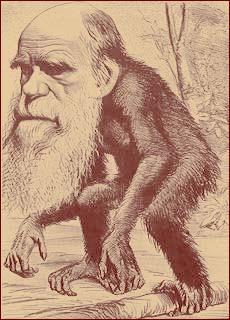
Giving Darwin Away

One of the most important books you never read ...

Talk about strange bedfellows: the Christian Science Monitor reports on the project of an evangelical minister to distribute thousands of copies of Charles Darwin's The Origin of Species on college campuses around the country, just in time for the 150th anniversary of the book's first publication.


True, there is some fine print. The minister has put out his own edition, which includes an introduction of his own that refutes the book and admonishes readers to "read the Bible daily and obey what you read." Even so, I think it's a swell idea because it means that some percentage of college students will actually read the whole book who might never have done so otherwise. And I have enough faith in Our Youth to trust them to sort it out for themselves. I've met some of them and would stack their wits up against those of any other generation, be it X, Y or Z, that you would care to name.

But you don't have to wait for someone to walk up and foist one upon you -- why not pick up a copy? Many editions are available, including free digital ones for your ebook reader (visit feedbooks.com). I have a nice little pocket sized hardbound with gilt edged pages put out by Barnes & Noble's Collector's Library, which sells for only $5.95.

With all the furor that continues to surround Darwin's work, you might think that by now everyone must have read it since they have such strong opinions on his ideas. Of course, the opposite is the case. Many of the strongest opinions, both pro and con, are voiced by people who have only heard about those ideas at second hand. And depending on what the source of their information is, they may be seriously misinformed. The book itself languishes unread.

Indeed, most of the fuss is about the origins of human beings, and so complaints should be directed not against Origin, but Darwin's later work, The Descent of Man. But it is true that he was only following to its logical conclusion the theory of evolution by natural selection which he had laid out in the first book. And by then it was obvious to anyone who had understood what he was saying that human beings were part and parcel of the same natural order, and must have arisen from earlier forms of life just as all other species had done.

Curiously, the work had a warmer public reception when it debuted, at least in some circles, than it has now. Boiled down to the misleading summary, "survival of the fittest," it was seen to explain the superiority of European civilization, and to lend the weight of historic inevitability to the colonization and subjugation of the rest of the world. "Man," as humans were known in those simpler and less politically correct times, had emerged on top of the heap of Nature, and white men were destined to be on top of the heap of other races.

Of course this is as much a misinterpretation of Darwin's work as it is to believe it is an affront to God or a justification of atheism. Darwin may have been a bit on the fence as to the role a Creator may have played in all this, but his intention was simply to explore the nature of things as they are, and to learn from that how they may have been in the past. He sought an answer to the question not of who created us, but how it happened. It was an audacious project, especially given that so little was known at the time about the mechanism of heredity. DNA was more than a century in the future, and not even genes had been hypothesized yet.

In his meticulous, almost plodding way, Darwin worked his way from observations of domestic breeding of livestock, to differences between isolated populations of animals, and ended up with the first really plausible explanation for the variety and progressive changes that can be seen everywhere in the world surrounding us.

Maybe the word "plodding" is unkind, but Darwin's carefulness bordered on the compulsive. He labored over Origin for twenty years, during which time Mr. Wallace came up with basically the same idea and almost beat him into print, in which case it would now be known as Wallace's Theory of Evolution. Thanks to the fairness of peer review, it was agreed that the two gentlemen would both present their papers at the same time. Neither of them made much of a stir at first, but once the dust settled Darwin was credited with precedence and by far the most thorough working out of the idea.

After all that, it's amazing to see the author apologizing in his introduction for what he evidently considered to be a sort of first draft or summary of his ideas! "This Abstract, which I now publish, must necessarily be imperfect. ... No one can feel more sensible than I do of the necessity of hereafter publishing all the facts, with references, on which my conclusions have been grounded; and I hope in a future work to do this."

If the 500 pages that follow are to be considered sketchy, what might his full treatment have amounted to? Something on the scale of the Britannica, I suppose. Anyway, I commend them to your careful attention. After all this time and all that has been learned since, this book still stands as one of the principle landmarks in the history of human consciousness, the time when we first turned to look back from where we came and discerned the first inklings of the tracks we left behind us in the sand.

As many more individuals of each species are born than can possibly survive; and as, consequently, there is a frequently recurring struggle for existence, it follows that any being, if it vary however slightly in any manner profitable to itself, under the complex and sometimes varying conditions of life, will have a better chance of surviving, and thus be naturally selected. From the strong principle of inheritance, any selected variety will tend to propagate its new and modified form.
- Charles Darwin, Introduction to The Origin of Species

Thursday, February 12, 2009

Happy Birthday, Mr. Darwin

Attacked by the religious right, he could be done in by the atheists ...

Elsewhere in this meandering blog I have railed against those who would have us throw science out of our schools and embrace a world view which is on a par with believing in a flat Earth sitting motionless at the center of the universe.

But I'm equally irked to hear that a local Atheist Society is vocally supporting a celebration of Darwin Day. Don't the Creationists -- I mean, Intelligent Designers -- have enough arguments already without a bunch of disbelievers feeding the frenzy by confirming the idea that Darwin's theory is tantamount to godlessness? This is like a US political candidate getting an endorsement from the Communist Party -- thanks for your support, guys, but ...

Now, I don't mean to demean atheists by comparing them to Communists. Even though Karl Marx famously condemned all religion as "the opiate of the masses," and even though the Soviet Union worked diligently to stamp out religious practices, there is of course no reason why a believer in democracy can't also be a disbeliever in divinity -- and many are. But my complaint is that by publicly endorsing Darwin's theory at a time when it is a source of such contention, they are only making things more difficult. And by appearing to embrace the theory as evidence to support atheism they are doing as much harm to the truth as those who consider it a negation of religion.

The reality is that Darwin described a mechanism to explain the observed fact that species change and evolve over time. He realized that human beings were an integral part of this process, and must have emerged from earlier ancestors just as all other plants and animals have done over the billions of years since life first came into being on our planet. Anticipating the furor that could result over this concept, he waited twenty years before publishing it, and was nearly beaten into print by Alfred Russel Wallace, who came up with the same theory independently. This is yet another example of how the truth will emerge when the time comes, regardless of who takes the credit. It would be no different to us today if it were called Wallace's Theory of Evolution.

As products of their age, neither man was an atheist. It was a time when science and religion were seen to cooperate more than compete. Wallace in fact had some wild ideas of spirituality that made him suspect in the scientific community. But their work was not done either to prove or disprove the existence of God. It was simply to learn more about how our natural world works, and to learn more about our place in that world.

So I have similar questions to pose to both ends of the radical spectrum. If you are a fundamentalist Christian, can you not still find wonder -- even greater wonder -- in considering a God who brought a whole universe into being in a single explosive instant, and who molded its stars, planets, and living things with a single set of basic rules that made it inevitable that beings like ourselves would arise from the dust? And if you are an atheist, can you not find the same sense of wonder in contemplating that same universe, and can you not admit that your sense of awe in the presence of that reality corresponds to what the religious feel in the presence of their God?

We are all human. We all belong to the same world in the same cosmos. And none of us really knows why. All the rest is argument about terminology.

  
Google celebrates Darwin

Sunday, February 24, 2008

Evolution Yet Again

The creationists are back, but the new law cuts both ways ...

In past posts (here and here) I've written about the shoving match going on between, on the one side, those who distrust Darwin's theory and consider it an attack on their religious beliefs and God's Own Word and who therefore want everyone in the public schools to be instructed that it is not a fact but only a theory and that there is a perfectly plausible alternative in the form of Intelligent Design that explains why it is more logical to believe that God just built everything exactly the way it is without any need for later revisions--between those people on the one side, and on the other, well, everyone else.

Alas, now in my own home state, nicknamed "Sunshine," the legislature has seen fit to write into law a two-edged solution to this so-called debate. On the one hand, they prescribe that evolution must be taught "as a theory, not a fact." But on the other hand, they say that it must be taught, which they have not decreed in the past.

I suppose we could take comfort in this. At least our students will not be denied all exposure to Mr. Darwin's excellent work on the subject. But I fear that more harm than good is being done because of the endorsement of such muddy thinking. Besides the bogus issue of fact versus theory (or fact versus fiction), one news story actually reported the following:

"Evolution would have to be taught as a theory, like Einstein's theory of relativity, rather than as a fact, such as Newton's laws of gravity."

Ouch! Can you feel me cringing? Last I heard, Einstein's formulas were working pretty well when it comes to things like generating nuclear power, explaining why the sun hasn't burned out yet, and turning cities into smoldering piles of rubble.

Mr. Newton, on the other hand, despite his laudable attempts to at least describe what gravity does, never told us anything about what it is. Furthermore, his "laws" have since been found not to apply at the small scale of subatomic particles, and to be less than complete when considering the universe as a whole. For many years now, Einstein's theory has been accepted to have superseded simple Newtonian physics, and is now being superseded in turn by quantum and string theories.

So first of all, can we not agree on the definition of a theory? A theory is an idea that explains the observable facts. So right away, we agree. OF COURSE EVOLUTION IS NOT A FACT -- BECAUSE IT'S A THEORY THAT EXPLAINS FACTS. WHO CALLED IT A FACT? I'm pretty sure the first people who dubbed it a "fact" were Creation--er, I mean Intelligent Design activists.

Here's how it works:

  • A fact is: The sun appears in the eastern sky each morning, at a predictable time, and disappears, also predictably, in the western sky each afternoon.
  • One theory to explain this is: The earth stands still at the center of the universe, and the sun goes around the earth once a day.
  • Another theory is: The sun stands still at the center of the universe, and the earth rotates around its own axis once a day, which makes it seem as if the sun is moving.

The first of these theories was long held to be so abundantly obvious (and scripturally correct) that it defied questioning. Copernicus was threatened with excommunication from The Church (you remember, the one and only church in Rome?) unless he withdrew his proposal of the second alternative. But in science everything is a theory except that which can be observed. And all theories remain open to revision indefinitely. Theories are tested by how well they explain the observed facts, and whether they can predict the outcome of further measurements and observations that could only be expected if they are correct.

People went to great lengths to cling to Theory Number One, even calculating the ornate loop-the-loops that the planets would have to perform to explain why the earth was still the center of everything. But in the end they just couldn't keep it up. The weight of the accumulated observations tipped overwhelmingly in favor of Copernicus and Theory Number Two. Plus, Theory Number Two could also explain the seasons, the length of the year, and solar and lunar eclipses. Maybe this made it easier when Theory Number Three came along and explained that the sun wasn't the center of the universe either, but only one of the billions of stars in the humongous whirlpool of the Milky Way Galaxy--oh, and by the way, that there are billions and billions of other galaxies out there, and we're not at the center of them, either.

Now along come the Intelligent Designers, as I think I will call them, and want us to convince our school kids that Theories Number Two and Three are just theories, not facts, and that there is a perfectly sound reason to keep believing in Theory Number One. Shall we also put in a word for Theory Number Zero, "the earth is flat?"

Opponents of evolution may protest that they are not advocating against any other scientific theories, only that one. (Not yet, anyway.) But I have deliberately used the example of a different theory--one which seems to be generally acceptable to everyone now-- to illustrate the point that we have more to fear from ignorance than from knowledge of the truth, whatever it may turn out to be. And once we begin to travel the path of ignorance, how will we ever know where to draw the line?

Humans have not been diminished by our exclusion from the center of the universe, as was feared in the past, nor have our faiths and social institutions collapsed. We have not thrown up our hands at our insignificance in the scheme of things. Instead we have grown in stature by virtue of our knowledge, and have hugely expanded the size and grandeur of the universe we live in. Rather than this single cramped stone we call home, roofed over by a lid full of twinkling lights, we now inhabit a vast space full of an endless variety of other worlds, and it is all laid out for us to explore.

So before we throw out the baby, bathwater, and washbasin of science altogether, I've got a better idea: How about if we also teach all the alternative creation myths from throughout history and around the world? Shouldn't our kids know that Adam and Eve in the Garden is just a theory, not a fact, and that others (Hindus, for example) have believed the world swam through the sea on the backs of four elephants standing on a turtle and surrounded by a giant snake? Wouldn't our kids end up learning more that way?

Of course, this is just a theory. But we could test it ...

Wednesday, November 09, 2005

From Primordial Soup to Immemorial Nuts


I just picked up a couple more fragments of information on the "Intelligent Design" issue (is it only coincidence that the initials are ID, as in "unconscious mind?") and thought they deserve comment.

It seems those "gaps" they talk about are gaps in the fossil record, as if the theory can be demonstrated only by uncovering the remains of every version of every animal that has ever existed--or at least enough of them so a smooth progression of forms can be laid out in a museum.

Of course, that is asking the impossible. The conditions that produce good fossils are rare and random, and finding them can be quite a task in itself. It's a miracle we have found as many as we have and that careful study of them has revealed as much as it has. Even so, there is plenty of evidence from comparative anatomy of both living and extinct animals to be able to chart their development and their relations to one another.

That's not to say that we fully understand it all yet, or that there may not be surprises in store. It was a recent discovery that the dinosaurs may be more closely related to modern birds than to modern reptiles--that they may in fact have been warm blooded. But this is another example of how our knowledge of the present can help us shed light on the past. Rather than throwing up our hands at the "complexity" of it all and falling back on Divine powers to explain it, we are rewarded by pursuing careful observation and logical analysis.

Another "gap" is the mystery of what happened in the Cambrian period when a tremendous proliferation of new forms of life appeared in the relatively short space of about five million years. Was this God fanning the flames? We don't have a definite answer yet, but there is a fascinating solution put forward by Andrew Parker in his book, In the Blink of an Eye (here's a review).

Observing that the eyeball originated during that time, he proposes that it was the refinement of vision that explains the surge of evolution. Suddenly, geologically speaking, predators could see their prey better and prey could see the predators coming. Mates could find mates by appearance. So issues of coloring, locomotion, speed, and reflexes all became dramatically more important than they had been.

For the purposes of this discussion, it doesn't even matter if Parker is right. It's a wonderful and plausible example of how we can figure things out.

The last "gap" is the supposed lack of evidence for the "primordial soup" of organic chemical compounds in which life, it is thought, first formed. This is admittedly a big missing piece, but we are not without clues. We know so much about the molecular structures of living things that we can begin to make educated guesses about what sort of conditions would be necessary for simpler chemical compounds to link up into something that can reproduce itself. One thought is that lightning may have played a part--how's that for Divine intervention! Dramatic enough for you?

But the eventual proof of this will probably only happen if and when we can recreate it in a laboratory (wait till you hear the screams of protest over that) or if we find it taking place on another planet, which is far less likely to happen. We won't see it here on Earth, of course, because the conditions have changed. The atmosphere we breathe has been created by living things, and is no longer the harsh mix of gases that must have existed In the Beginning.

Maybe if we could just find the Primordial Can that the Primordial Soup came from ...

Thursday, October 06, 2005

Let's All Evolve!


All right, I've had enough. I've just read one too many news stories where the Christian myth of Creation is being compared against the scientific theory of evolution as if they are two competing products vying for market share. In reality (I do believe in that) they are as different as a ghost and a machine, spirit and flesh. One requires faith and a belief system to create a subjective experience of something immaterial, while the other examines physical evidence and attempts to propose logical and demonstrable explanations for what we see around us.

The bullet points being hammered home by the "intelligent design" proponents are (1) "evolution is not a fact," (2) "life is too complex to be explained by evolution," and (3) "evolution has unexplained gaps it cannot account for."

I beg to differ. First of all, evolution is a well-documented phenomenon which can be observed in the species alive today, and inferred from studying the remains of those now long extinct. I think what they really mean, though, is not evolution the observed phenomenon but the theory of evolution by natural selection, which is the current state of understanding how evolution happens.

Basically, as Darwin proposed, populations of every species are composed of individuals with genetic variety and differing traits. When the population is subjected to stresses, such as the introduction of a new predator or parasite, loss of food supply, or a change in climate, some members of the population do better than others due to the set of traits they have. These members are the ones who survive and produce more offspring, so that their traits become prevalent in succeeding generations. The changes may be so minute they are unnoticable, or they may be sudden and dramatic. Genetic variations may be as mild as the color of eyes or as drastic as mutations that make it impossible for the individual to survive. So over hundreds of millions of years since it arose, life has taken infinitely varying forms. The forms that didn't work or couldn't adapt died out, while others survived ... and here we are, the living continuation of this endless chain of flux.

While we can agree that a theory is not a fact (theories exist to explain the observable facts), many theories demonstrate their usefulness every day as we make use of the technologies that have been based on them. We can start our cars, turn on our lights, watch TV, and detonate nuclear weapons without anyone disputing the fact that they work. This is even true when the theories have "unexplained gaps." We were already sending telegrams and using electricity long before we knew what electrons were, or how atoms were composed. Theories take us as far as they can, then allow us to proceed from there on the basis of new knowledge.

Complexity is certainly abundant in life, but there is no reason why simple fundamental processes cannot give rise to complexity. This can be demonstrated very simply through mathematical exercises like fractals and cellular automata, which can create "lifelike" forms from extremely basic rules. In fact it is the complexity of a population--its genetic diversity--that allows natural selection to operate effectively. It could be argued that the more complex life is, the better natural selection works.

I assume the "gaps" they talk about in the theory of evolution (let's make an acryonym: the Theory of Evolution by Natural Selection, or TENS) are (1) it doesn't explain how life began in the first place, and (2) it doesn't explain why there is a universe for us to live in, or in other words answer the question of Why Are We Here?

So in response to those issues:

(1) "TENS" is not about the origin of life. There are other hypotheses (not theories yet) about how inanimate matter may have formed the first cellular organisms, but if Natural Selection played a part in it that would really be a separate issue. However, if and when there is a working theory that demonstrates how this transition can happen, then it, too, like the theory of natural selection, should obviously be included in the science curriculum of our schools.

(2) Science is not about Why, it's about What and How. There are other forms of human inquiry that address the Why question. They are known as philosophy and religion. Far from being antagonistic to one another, all of these disciplines serve us best when they complement each other, when what we know of the world informs our speculation about what we do not know.

Personally, I believe that the universe around us is the body of the supreme, self-existent being we call God, and that our minds are tiny inklings of the vast intelligence of which we are small parts. But I don't believe that God sits on a cloud or in an office somewhere and micromanages all of creation. The divine power I imagine, glimpsed through the insights of physicists and cosmic theorists, is one that sparked a whole cosmos into being from a single point, that established from the instant of its beginning all the laws that would govern the behavior of everything from atoms to stars and galaxies, that built these laws into unimaginably small bits of energy (currently called "strings") which make up everything we see and everything we don't see. This is the power that made life in such a universe an inevitable, "natural" development. All we can do is study the details of how it has happened, and to marvel at its wonder.

For me, science supports my religion, so I'm all the more amazed when others feel their beliefs are threatened by it. Relax, I want to tell them; we're all in this together. By all means, read your Bible stories to your children, teach them how to behave in moral ways, how to live with one another in peace. But for God's sake don't deny them their right to know as much as possible about the world around them, even if--especially if--that knowledge forces them to wonder about what they know and how they know it.

Please, let's evolve beyond this petty debate.