-->
Showing posts with label book fair. Show all posts

Wednesday, November 24, 2010

Book Fair 2010

It's great even when abbreviated ...


This was year 27 of the Miami Book Fair International, and year 50 of its host, Miami-Dade College. I've been attending ever since year one -- even the year when most events were canceled due to severe weather -- and I'm ashamed to say how close to its beginning I attended Miami-Dade College. (Hint: it was the first year of South Campus when we had to attend classes at my old high school because the classroom buildings weren't finished yet).

I could only make it for the final day of this year's fair, but I appreciated all the more the few events I could attend. I started out with some levity in the Mateo Theater, an intimate space with a semicircular stage only about a dozen feet across. T. Cooper presented his odd little work, The Beaufort Diaries, about a polar bear who goes Hollywood. This graphic novel has spawned a video and might grow up to be a feature someday, especially with the attention it's gotten from David Duchovny and Leo DiCapprio. Here's what he showed us, as projected from his MacBook.

Then Vicky Hendricks, Miami's femme fatale of noir, gave us part of a story that takes place in Key West. Let's just say the place is going to the dogs. But you already knew that. This is from her new collection titled, aptly enough, Florida Gothic Stories, a follow up to her appearance in the collection, Miami Noir.


Finally Preston Allen, my old compadre from the Butterfly Lightning reading series (the website is gone but you can still view it at the Internet archive), read from his latest novel, Jesus Boy, about the steamy relations between bible thumper Elwin Parker and a lady old enough to know better. The book has a serious message that goes down more smoothly with its chuckle-provoking coat of sugar.

Fortified by this trio, I felt ready to face Writing On The Edge, an anthology of articles by fiction writers who were invited to witness the work of Doctors Without Borders. Tom Craig interviewed two of these writers, Damon Galgut from South Africa and Hari Kunzru from Great Britain. All the while they were accompanied by a running slide show of images collected from around the world, wherever the good doctors are involved in providing relief.

As the presentation progressed I began to be overwhelmed by the sheer scale of the problem. As it happened, the evening before I had attended a fundraiser for an organization called ProNica that assists the poor in Nicaragua. Coming from that narrow focus on a single locale in a single country, it was devastating to see the same scenes repeated in nation after nation. Just to give you an idea, here's a partial list that I jotted down from the captions in the slide show:

Armenia ... Assam ... Burundi ... Cambodia ... Chad ... Congo ... Morocco ... Palestine ... Sierra Leon ... Somalia ... Sudan ... Ukraine ... Uganda ... and as you can see from the gaps in the alphabet there are many more. One of the panelists quoted Harold Pinter, who said simply, "Most people in the world live in hell." What can be done? Well, if you're a doctor you can sign up for a six to nine month stint in hell, and wake up every day knowing that you will save one or more lives. If you're not a doctor, you can send them some money. It's not much, but it's a start.

After this it was comforting to get a longer view of history. Biographer Stacy Schiff's latest project is Cleopatra:A Life -- though, as she said, considering that her subject lived from 69 to 30 BCE, she wasn't sure if it was biography or paleontology. It's one thing when you can read all of Ben Franklin's letters or interview everyone who knew Richard Feynman, but quite another thing when 2,000 years have passed and the person of interest is a feature of ancient history. Schiff reminded us that over the intervening years the language, culture, religion, and calendar have all changed. Even the topography of Egypt is not what it was -- it's flatter -- and the Nile itself has moved over two miles from where it used to flow.

Given this, she appears to have done wonderful work by going back to the available sources -- what the Romans of the day had to say about Cleo -- and cutting through centuries of myth and romanticism. One notable correction is that the notorious queen was not known for her beauty but for her charisma. Hey, Marc Antony, you're going to love her -- she's got a great personality! She also had an unerring knack for who to get pregnant with, and when. Not a bad way to play the game when you're in the business of hereditary rule.

After grabbing a crepe in the food court I wrapped up my day with a duo of poets (Jim Brock, where were you?). Geoffrey Philp read to us from Dub Wise in his mellifluous Jamaican voice, and Nina Romano from her latest collection titled Cooking LessonsDon't let this title fool you, though. This is far from an episode on the Food Channel, and Nina evokes far more of life than the satisfaction of appetites. I was particularly taken with the poem about an encounter with a deer in its death throes on a high and dark mountain road. I still have the chills to prove I was listening.

Until next year ...
Times are hard ... anyone want to buy a paper?

Sunday, November 23, 2008

Marketplace of Ideas - Part II

Continuing my saga of this year's Miami Book Fair ... If you missed it, you might want to start with Part I.


Sunday

... Beginning with Peter Matthiessen, who has finally (after seven long years) reduced the epic trilogy that started with Killing Mister Watson into a single volume called Shadow Country. It seems to me that this project all by itself could qualify him for a Nobel Prize, or at least a lifetime achievement award from somebody. Actually he's up for the National Book Award, and he would have my vote if I had one.

His long-time interest in this subject began when he was a teenager on a fishing trip with his father in Florida bay. Their boat passed the ruin of an old house on the shore, and their guide told them "that's the old Watson place," and gave them a short version of the tale: how the evil Watson had been shot dead by a unanimous collection of his neighbors, a weird case of vigilante justice. The story hooked young Matthiessen like a fish.

He's 81 now, and eventually ended up spending a big chunk of his writing life pursuing the truth behind the legend and turning it into an exhaustive and definitive work. The new version should not be considered an abridgment, according to the author. Rather, the book has finally reached its intended form.

The original 1500 page version "frightened the publisher," who convinced him it could only be printed in three separate volumes, reduced to a mere 1300 pages. However, according to Matthiessen, the middle volume never worked as a novel in its own right even though it contained much of the best material. So he kept on going, and has finally honed it down to 900 pages crammed into a single narrative, as he originally intended.

In response to a question from the audience, he revealed that he reworked many of the characters in the process, eliminating or toning down some while bringing others to the fore. One example was the solitary black citizen whose bullet was "the first one to strike Watson, and the only one needed." In the earlier version he appeared but had no voice in the narrative; in the new version he has much to say.

So, OK, Mattheissen has done his part and it's up to the rest of us to meet him half way. I finally have to read the durn thing. Looking forward to it immensely.

Briefly -- because I could go on at great length about both of these -- the second session concerned (1) Marshall Goldman's Petrostate: Putin, Power, and the New Russia, which describes the strangle hold that Russia has on Western Europe though its gas pipelines, and (2) Andrei Cherny's The Candy Bombers: The Untold Story of the Berlin Airlift and America's Finest Hour. (Yes, two more examples of subtitles. They're everywhere.)

This second one forced me to revise my ideas about the occupation of Germany after WWII. We like to think we were welcomed as liberators and immediately used the Marshall Plan to rebuild the country in our own image. The reality was much more in line with our current experience in Iraq.

[Begin digression:]
The victorious allies started out with the idea of destroying Germany and its industrial capabilities far more thoroughly than had been done at the end of the First World War. The population was fed a starvation diet during three years of occupation, and opinion polls showed the vast majority of Germans would prefer living under Communism if it would guarantee them full stomachs.
But then the closing of the East German border by the Soviets and the isolation of West Berlin led to the Berlin Airlift, a conveyor belt of airplanes, one every 90 seconds, that kept the city's supply line open for nearly a year. In the midst of this, a simple act of human kindness, when an American pilot decided to drop some candy to the kids down below, became an international symbol of resistance and good will, and resulted in a reversal of public opinion in the rest of Germany.
More importantly, during those eleven months Harry Truman got re-elected and created the Marshall Plan to do for the rest of Europe what the airlift had done for Berlin -- foreign aid on a scale never seen before or since, and surely one of the best investments America ever made.
A slogan of peace activists is "Wage Peace" -- the idea that if we put the same resources into conflict resolution that we put into warfare, there is no telling how far we can go toward making a more peaceful and prosperous world. And if there is any doubt about whether it would work, just consider this question: Which was more responsible for building the resurgent continent of Europe as we know it today -- destroying its cities with bombs, or bombing its children with candy?
[End of digression.] Well, I warned you I could go off on either of those topics, so that was it.

Before heading to my last event I hit the streets again. This time I turned up some bargain jazz CD's at the WDNA booth -- two for five bucks, with a free bumper sticker thrown in. I can now proclaim "I [heart] Serious Jazz" on the back of my van. Along the way I also had a nice chat with a man giving away pamphlets that proclaimed "Islam - Religion of Peace." Amen to that. (You can read about it at www.alislam.org.)

Words in Pictures

Normally, graphic novels (meaning the ones that are mostly pictures, not the ones full of explicit sex and violence) give me the willies. They are too similar to those wordless pictorial newspapers in Ray Bradbury's Fahrenheit 451, which were all people had to "read" after they had burned all their books. Nevertheless, I attended a session featuring four artists and their books, and came away very glad that I did.

First off, our friend Youme Landowne presented Pitch Black, a project she did in collaboration with Anthony Horton, a man who she met on a subway platform in New York and ended up following into the subterranean depths of the city to visit the tunnels where he had lived for some years. This slender volume belies the power of the story it tells, fittingly in stark black and white. I love the opening epithet: "Just 'cause you can't see don't mean ain't nothing there."


Ms. Landowne's Selavi, a children's book about a group of Haitian orphans who started their own radio station (true story!), received a lot of attention and four awards, including the Jane Addams Peace Award. It appears Pitch Black will extend her reach to an adult audience.

Swiss artist Alex Baladi showed several of his books of comic-style art, including Frankenstein -- not a retelling of the story, but set in his home town of Geneva which, he reminded us, was the original setting of Mary Shelley's novel.

Then Ralph Penal Pierre, from Haiti, impressed us with a comprehensive rapid-fire slide show of his highly professional illustrations. He's a working artist, making his way in one of the most difficult economies in the world by cranking out slick commercial work as well as his own creative projects. On the drawing board now: a highly realistic (in style) book-length "monologue on peace." Amen to that again.

Finally, syndicated cartoonist Stephanie McMillan, who publishes her daily strip "Minimum Security" online, introduced us to her first graphic novel titled As the World Burns, in which a half-blind bunny who escaped from a mascara testing lab joins the good fight to save the world from an army of alien robots. Stephanie herself is a bright-eyed young woman who talks cheerfully about reading a Communist newspaper and wittily about nearly everything. I haven't enjoyed having the comics read to me so much in ages.

Concluding on this upbeat note, that there is humor even in the end of the world, I departed with my autographed copy of Pitch Black resolved to come back again next year -- assuming we all survive that long -- and to have read a lot more books.

Saturday, November 22, 2008

Marketplace of Ideas - Part I

The Miami Book Fair turns 25 ...


The world economy may be tanking, the value of your home and retirement funds may be shrinking before your eyes, but if the Miami Book Fair is any indication then the marketplace of ideas is still alive and thriving.

I doubt that even its most ardent supporters back at the beginning expected it to be the runaway success it has been, but our good old Fair has become the premier event of its type, and it just keeps on coming. Even with the five-dollar admission fee now being charged, the streets are packed, readings are filled to near capacity, and appearances by people like Art Spiegelman have to be managed by distributing tickets. Tickets! To hear a writer! Is this great or what?

Once again C-SPAN (their broadcast van still labeled "Campaign 2008") parked in the street to pump select venues to a national and international audience by television and the Internet. (The oddest of bedfellows: "Book TV.") All of this serves up as rich and varied an assortment of thoughts, fantasies, memories, histories, essays, and poetry as you might care to imagine.

My visit this year was somewhat more abbreviated than the marathon session I described a couple of years ago, but it was still packed with stimulating material.

Saturday

The first session I attended was the troika of Florida International University professors and alumns: John Dufresne (please pronounce it "Dufrayne"), James Hall, and Dennis Lehane (rhymes with Dufresne -- and you'll understand why I emphasize it if you were there).

Dufresne's latest novel is Requiem, Mass., a title so fortuitous it's amazing no one has used it before. It makes me think of an exercise that John is fond of giving to his creative writing classes: First you come up with the name of a town (mine was Sheetrock, Fla. -- you can use it if you want to), then describe walking through it, then walk into one of the buildings, then meet someone ... perhaps they speak to you, or you to them ... and before you know it you are waist deep in a new piece of fiction.

In this case however Requiem is a fictional Worcester, so the town preceeded the name, and the main character is a sort of fictional Dufresne who "like me comes to Florida and works in my office but is not me." Obviously some of the material owes a lot to John's life, though the division between fiction and memoir has never been more murky. Perhaps if the oft-stated equality between the two is correct then we should give up trying to tell the difference. (Didn't Jack Kerouac do that many years ago?)

The first passage John read was a delightful though hair-raising confrontation between the boy Johnny and his authority figures in Catholic school, attending which "is a scab you pick for the rest of your life." I will only say that amorous priests are not the only things to beware of -- watch out for those vicious nuns!

The other selection about the fate of his first-crush babysitter was classic Dufresne, gentle, cruel, dispassionate, and heartbreaking all at once. Kind of like life.

James Hall -- who, along with host Les Standiford, was responsible for bringing Dufresne among us and establishing the excellent writing program at FIU -- is well known for his dramatically plotted mysteries. Today he shared a new twist on murder, that of a young woman killing an older one, which is a combo he's never dealt with -- although he freely confessed to killing many of his characters over the years, and in bizarre ways, too.

He is, in fact, a veritable poet of the genre, and this example from Hell's Bay is no exception. Both murderer and victim are carefully drawn, and the moment of truth approaches both breathlessly and meticulously. The setting itself adds the perfect ironic touch -- the idyllic Peace River in Central Florida.

Dennis Lehane, the FIU grad who has been following along in the successful wakes of his mentors, has just produced his most prodigious novel. At 700+ pages, The Given Day takes place in 1918, but before you start yawning let me hasten to add that it includes some of the snappiest writing about baseball I've ever heard. Babe Ruth lives!

In the second session I caught Scott Simon, one of NPR's most mellifluous voices, reading from Windy City: a Novel of Politics. This is about the best time I can think of to come out with a political piece set in Chicago -- and it's funny, too. Simon says his aim was to do something "about 80% humor and 20% serious." Sounds like a wild ride. And Simon showed off his acting abilities as he impersonated his character, Mayor Sonny Rupini, with great gusto.

Simon was also the first, but not the last, to elicit applause by referring to the recent election results. People are still gushing, and ever on the lookout for ways to show enthusiasm for our new President-Elect.

Also sharing the podium was Russell Banks, who has produced a meditative monologue on the American character called The Reserve. This began when he was interviewed for a French film the aim of which was to show the contrast between America as seen by its writers and America as perceived by the French through American cinema. How convoluted is that? Keep in mind it's a film about that, to be shown to the French.

Over eleven hours of interview was condensed to less than an hour in the film, so Banks took the entire transcript and edited a more complete version into book form. It appears to be full of insight, and of course beautifully written.

My apologies to Alan Cheuse -- who appears to have struck a similar chord in To Catch the Lightning: A Novel of American Dreaming -- for having to duck out during his reading. You can't be everywhere at once. But let me just ask publishers ... is it the latest thing that novels have to have subtitles so you will know that they're novels and what they're about? I thought that's what cover blurbs were for.

Anyway, I had just enough time left to consume my once-per-year arepa (a kind of grilled-cheese sandwich made with discs of sweet cornbread, yum) from the Arepa Queen in the food court, and to pick up a couple of bargains at the book stalls. Penguin was giving away free books containing sample chapters from eight of their current best-sellers, the first time I've seen that. "Collect the whole set," said the booth jockey with a grin. The Nation had free sample issues to hand out, including the one from election week. And I purchased one hardback from Florida University Press, a history of Florida railroads.

The book was $21, marked down from the retail of 27.50, so I saved more than enough to pay for my arepa. I don't know how business was overall, but it appeared brisk, at least to judge by the amount of browsing going on. However, I did see a sign at Pineapple Press, a publisher of books about Florida, that said ALL BOOKS 25% 50% OFF -- something you don't usually see until the final day of the fair.

And that brings us to ...

[Part II will be posted on Sunday.]

Monday, November 21, 2005

A Day in the Life of the Book Fair


It's hard to believe, but I've been coming to the Miami Book Fair for 22 years, since it first began. During that time it rapidly matured from something that could have been a flash in the pan into the premier such event in the country.

Maybe it has something to do with publishers living in New York, which is growing grayer and colder by mid-November, while Miami is usually waiting for its first cool spell of the fall. But if it were only the weather, then surely mid-winter would be the time to insure the biggest draw.

Instead, what has insured the Fair's success is the maturing of community support. More than the existence of financial grants, it is the dedication of those who make it happen--people like Mitchell Kaplan, owner of Books&Books, our favorite area book store--and those who turn out in droves to attend the hundreds of readings it produces, not only on the weekend of the Street Fair but throughout the year.

The Book Fair plays no small part in supporting the community of writers in the region. Writers, both successful and aspiring, have an annual fountain of inspiration in their midst, a chance to see and hear and hang out with some of the most notable figures in print.

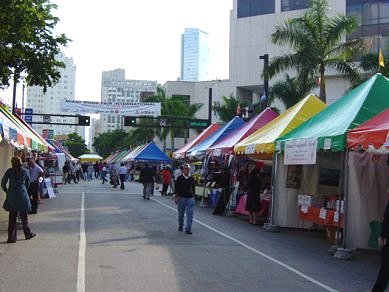
I long ago gave up trying to take it all in. It's not possible. The readings take place simultaneously in twelve different rooms ranging in size from the large auditorium that seats up to a thousand down to intimate classroom or gallery spaces--even, in the case of The Spoken Word Cafe, a tent. And they last from 10 am to past 5 pm. Even if you don't eat (and who can pass up the opportunity to purchase overpriced fair food washed down with a five-dollar lemonade?) and even if you try to limit yourself to the things that interest you most, there are still schedule conflicts that force you to make tough choices, or to duck out of the question session at the end of one reading and sneak into the middle of another one already in progress. On top of that, you have to find at least a little time to do some book shopping in the stalls on the street.

But then, that's the fun of it. For a reader, the chance to wallow in readings of this quality, so plentiful that you can't do them all, amid heaps and stacks and racks full of books, is a feast that naturally belongs where it is on the calendar, right before Thanksgiving.

Just to give you a taste, here's how my own choices ran this year:

Saturday

We arrived late but still caught the second of two travelogs. Elliot Hester, a native Miamian who spent a year making his way around the world, has written Adventures of a Continental Drifter. He entertained us with a tale about the night he was nearly beaten to a pulp by the martial arts bouncers in a tourist trap in Bangkok, saved only by his remote resemblance to boxer Mike Tyson. A lot more fun to hear about than to live through!

11:30 found us basking in the warm rays of Carribean culture. Robert Antoni took us through an all-night muddy bash during Carnival in Trinidad--enough to make you want a shower by the time he was done.

Then Pablo Medina shifted gears to the complete introspection of his cigar-maker invalid, a transplant from Cuba to Ybor City (near Tampa) where he was felled by a stroke and turned into a bed-ridden patient, unable to move. I've never heard such material so vividly portrayed since I read Dalton Trumbo's Johnny Got His Gun, about a more horrifically afflicted veteran of World War I.

Finally Marlon James captivated us with his gossiping old Jamaican ladies and an account of how the "Rum Preacher" came to a bad end. As they say in the islands, "soon come, mon."

At 12:30 it was time to do politics. We sat in on George Packer's presentation on The Assassin's Gate, his study of how things are going in Iraq (the short version: not well). Hard to believe there has been enough time for him to research and write on this subject while it is still unfolding daily, but his interviews with people "on the ground," as opposed to those in high places, have yielded rich fruit.

The other member of this panel (David Rieff had to cancel) was Jonathan Ralston Reid, a Canadian who has written The Collapse of Globalism. This is not something he's predicting, but something which has already happened, according to his interpretation. All the promises of the "new world order" having failed, with the opposite results all around us, does make it look as if the emperor paid too much for those invisible clothes.

I'm pleased to be able to count some of the authors as friends and mentors. After lunch we had poetry for dessert at the reading of James Brock (friend), Michael Hettich (maybe not quite friend but certainly acquaintance), and Campbell McGrath (closer to the mentor category since my workshop with him at the Seaside Writer's Conference). It was good to note how "friendly" these differing voices were with one another. And always a pleasure to listen to.

[An example of schedule conflict here -- one of our friends was notably absent because she just HAD to see novelist Amy Tan, currently appearing in another building.]

But we weren't done yet. At 4 p.m. we heard Bruce Feiler on Where God Was Born. Feiler is personally exploring the historical landscape of the Bible, visiting such places as the Garden of Eden (currently paved). His earlier work, Walking the Bible, will soon make an appearance as a Public TV documentary series. Consult your local listings.

Also on this panel was former poet laureate Robert Pinsky, who has written a scholarly Life of David. Most memorable for me in his presentation was the description of what happened to the Israelites after they arrived in the Promised Land. Miffed at the way they behaved, the vindictive God that they had back then arranged for an army to come in and move them back out. The lesson in this was that the important, essential thing was not having a nation, or a temple, or even a rabbi or priest, but that every person would have their own relationship with God. It was a maturing of the concept of religion, and emphasized that religious experience was directly available to each individual.

Sherwin B. Nuland was the final participant in this session, and introduced me to someone I was ignorant of: Maimonides, a Jewish philosopher of the 13th century who dared to correct the Talmud if it differed from the opinions of science. Where is he when we need him?

By now you catch the drift--we're only at the end of day one, and worn out. Time to ride the people-mover down to Pericone's Italian eatery, and to dine amid the outdoor foliage.

Sunday

We launched into Sunday with John Dufresne (both friend and mentor) who regaled us with more samples from Johnny Too Bad (which might have been titled The Further Adventures of Spot the Dog). I confess I have not yet finished this book, though I already own an autographed copy. The way things are going, John may have read it to me by then. He also gave us a new "found" story ("I no longer make things up, I just write them down.") about a green-card wedding and its aftermath.

John's partner for this session was Richard McCann, a new discovery for me. McCann's careful, intimate prose cuts close to the emotional bone. And I was delighted to hear him relate how long he labors compulsively over his revisions.

Interestingly, both authors had photographs to back up their tales, prompting me to think we should all have to prove the veracity of our fiction by presenting the evidence.

On the advice of my sister-in-law we hastened over to the auditorium at 1:00 to catch Jonathan Safran Foer reading from Extremely Loud and Incredibly Close. Mr. Foer is entirely too well poised and assured for someone of his tender years and has no right to be able to write as he does, with wonderful inventiveness and killingly accurate insight. Media hype has not obscured the scale of this talent which, if we're lucky, will be with us for quite awhile. Our time was well spent.

At 3:00 we attended Science Matters, which was broadcast live on CSPAN. It seems a new publisher, Atlas Books, is bringing out a continuing series of science books written by novelists for the lay reader. The idea is to come up with eminently readable and interesting treatments on the lives and works of scientists.

Judging by the three examples, the project is off to a great start. In The Discoveries, Alan Lightman has documented a number of scientific breakthroughs during the 20th century, ranging from Einstein's first theory to the discovery of the structure of DNA to measurements of the distance to the stars.

Rebecca Goldstein, a former mathematician herself, has written The Proof and Paradox of Kurt Gรถdel--a proof, she insists, which is accessible in its outline to the lay reader, with little math or symbols required. I'll let you know after I read it. I took a class in statistics once, and a year later I could no longer read my own crib notes for the final exam.

Finally, David Leavitt has written a new account of Alan Turing's invention of the computer. Titled The Man Who Knew Too Much, the book focuses equally on Turing's famous contribution to the breaking of the German Enigma code, his invention of all the key concepts used in computer design long before they could be built, and his persecution as a "security risk" due to his homosexuality. Having read the other Turing bio, Alan Turing, the Enigma, I look forward to this new insight into his life and work.

Finally, it was 4:30 and time for poetic dessert again. Philip F. Deaver, Andrew Glaze (who I met while hosting the Butterfly Lightning readings), Jesse Millner (friend), and Susan Wheeler collaborated to bring a perfect end to a perfect weekend.

Only 363 days until the next one. Book your rooms now.